
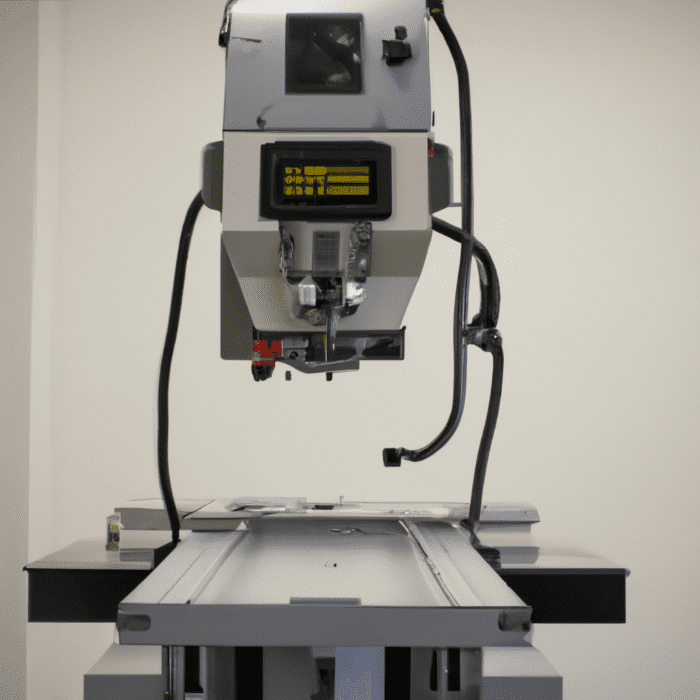
A 4×8 CNC router represents a significant investment for many fabrication shops and woodworking businesses. Its core capabilities are defined by several critical engineering components that dictate precision, speed, and overall operational efficiency. Understanding these features is paramount for selecting a machine that meets demanding production requirements and delivers consistent, high-quality results.
Modern CNC routers are complex systems, where each component plays a vital role in the machine’s overall performance. From material hold-down to tool changes and motion control, the integration of advanced technologies ensures optimal output and longevity.
Optimizing Material Hold-Down with Vacuum Table Zones
Effective material hold-down is fundamental for achieving precise cuts and preventing workpiece movement during machining. Vacuum tables accomplish this by creating a strong suction force across the material’s surface. A key feature for 4×8 routers is the implementation of multiple vacuum zones, allowing operators to concentrate suction on specific areas of the table.
Multi-zone vacuum tables enhance versatility, enabling efficient processing of both full sheets and smaller workpieces. For instance, a 4×8 table might be divided into 3 to 8 zones, with common configurations including 4 or 6 zones. This zoning capability allows for sealing off unused sections, thereby maximizing the vacuum force on the active work area.
Vacuum pump sizing is critical, with a general guideline of 5.5 CFM per square foot of surface area for spoil board or nested base tables. For a 4×8 (32 sq ft) table, this translates to approximately 176 CFM. Industrial-grade vacuum pumps often provide 9.5-10 inHg (inches of mercury) of sealed vacuum, with flow rates ranging from 200 CFM to 400 CFM, often achieved with multiple high-performance vacuum motors.
Ensuring Rigidity with Heavy-Duty Steel Gantries
| Feature | Typical Specification for 4×8 CNC Router | Key Benefit |
|---|---|---|
| Vacuum Table Zones | 4 to 8 independently controlled zones | Optimized hold-down for varied material sizes, reduced vacuum loss |
| Spindle Motor Power | 3 kW to 15 kW (4-20 HP) | Versatile material processing, high material removal rates |
| Spindle RPM Range | 6,000 – 24,000 RPM (water-cooled) | Fine finishes, efficient cutting across diverse materials |
| Spindle Runout Tolerance | ≤ 0.003 mm (0.00012 inches) radial | Extended tool life, superior cut precision |
| ATC Tool Capacity | 8 to 12 tools (linear or carousel) | Automated multi-operation machining, reduced downtime |
| Drive System Type | Helical Rack and Pinion (X, Y axes) | Smooth, quiet, and precise long-axis motion |
The gantry is a primary structural component of a CNC router, directly influencing the machine’s rigidity, vibration dampening, and ultimately, machining accuracy. Heavy-duty steel gantries are preferred over aluminum for industrial 4×8 routers due to steel’s superior stiffness and vibration absorption characteristics.
Steel gantries, while heavier, require larger motors and drives to achieve effective acceleration and deceleration. However, this increased mass contributes significantly to dampening vibrations inherent in the machining process, leading to better edge finishes and higher-quality products. Mild steel is approximately three times stiffer than aluminum of the same dimensions.
Properly engineered welded steel gantries provide exceptional long-term dimensional stability. The structural integrity minimizes deflection, which is crucial for maintaining tight tolerances, especially when machining harder materials or performing deep cuts. Target static rigidity for aluminum machining is typically 10-20 N/µm, while for steel cutting, it’s 25 N/µm or higher.
Powering Precision: High-Performance Spindle Motors
The spindle motor is the ‘heart’ of a CNC router, responsible for rotating the cutting tool at high speeds and delivering the necessary torque for material removal. High-power spindles, typically ranging from 3 kW to 15 kW (4 to 20 HP), are essential for processing a wide array of materials, including dense woods, composites, and even light metals.
Spindle speed, measured in RPM, directly impacts cutting efficiency and surface finish. High-speed spindles, operating between 18,000 and 60,000 RPM, are ideal for precision work, engraving, and cutting softer materials. Conversely, lower speeds (6,000-12,000 RPM) are better suited for heavy cutting tasks on dense materials where high torque is paramount.
Cooling methods are critical for spindle longevity and performance. Water-cooled spindles generally offer superior temperature regulation, often maintaining temperatures below 40 degrees Celsius, and are quieter than air-cooled units. They are often preferred for long, continuous operations and high-precision applications, achieving axial and radial runout of less than 0.003 mm. Air-cooled spindles, while simpler and more convenient, may generate more noise and are better suited for moderate workloads.
Spindle runout is a critical tolerance, indicating inaccuracies that cause a tool to spin off its ideal axis. For new precision machines, radial runout should be ≤10μm (0.0004 inches), with standard machines allowing up to 25μm (0.001 inches). High-precision aerospace or medical components often require runout of 0.002mm or lower. Excessive runout significantly reduces tool life and negatively impacts surface finish.
Streamlining Production with Automatic Tool Changers (ATC)
Automatic Tool Changers (ATCs) are indispensable for modern CNC routers, significantly enhancing efficiency and reducing non-cutting time. An ATC system allows the machine to automatically swap between various cutting tools without manual operator intervention, which is crucial for multi-operation jobs.
ATCs improve production consistency, reduce operator workload, and increase machining accuracy by ensuring the correct tool is used for each step. This automation is particularly beneficial for complex parts requiring multiple tools, high-mix production, or shops running multiple machines.
Common ATC types include linear and carousel (or drum) styles. Linear ATCs typically store 4 to 12 tools in a row, offering fast changes and high repeatability, making them suitable for woodworking and panel production. Carousel ATCs, with rotary magazines, can hold 8 to 20+ tools and are often found on high-end industrial routers, providing faster tool changes and greater capacity for complex tasks.
An ATC system comprises a tool magazine, tool holders, a gripper arm, and a control system that synchronizes tool changes with the CNC program. This precise coordination allows for seamless transitions between operations, such as cutting, engraving, milling, and drilling, without stopping the job.
Achieving Motion Accuracy: Rack and Pinion Drive Systems
For 4×8 CNC routers, rack and pinion drive systems are the industry standard for long travel axes (typically over 4 feet), where ball screws become impractical due to ‘screw whip’ at high speeds. This system converts the rotary motion of a motor into linear motion, driving the gantry or cutting head along the machine bed.
Two primary types of rack and pinion systems exist: straight (spur) and helical. Helical rack and pinion systems are generally preferred for their smoother motion, quieter operation, and better load distribution due to angled teeth that engage gradually. This design minimizes chatter and results in superior cut quality.
Backlash, the lost motion between the rack and pinion teeth, is a critical consideration. Excessive backlash reduces positional accuracy and can lead to tool marks or dimensional errors. Modern systems mitigate backlash through mechanical preload methods, such as spring-loaded dual pinions, or software compensation.
Helical racks, while offering performance advantages, generate lateral forces that require specially designed bearings, guide rails, and mounting structures to withstand the load. Straight racks are more cost-effective and simpler to maintain, but may exhibit more noise and wear over time due to simultaneous tooth engagement.