
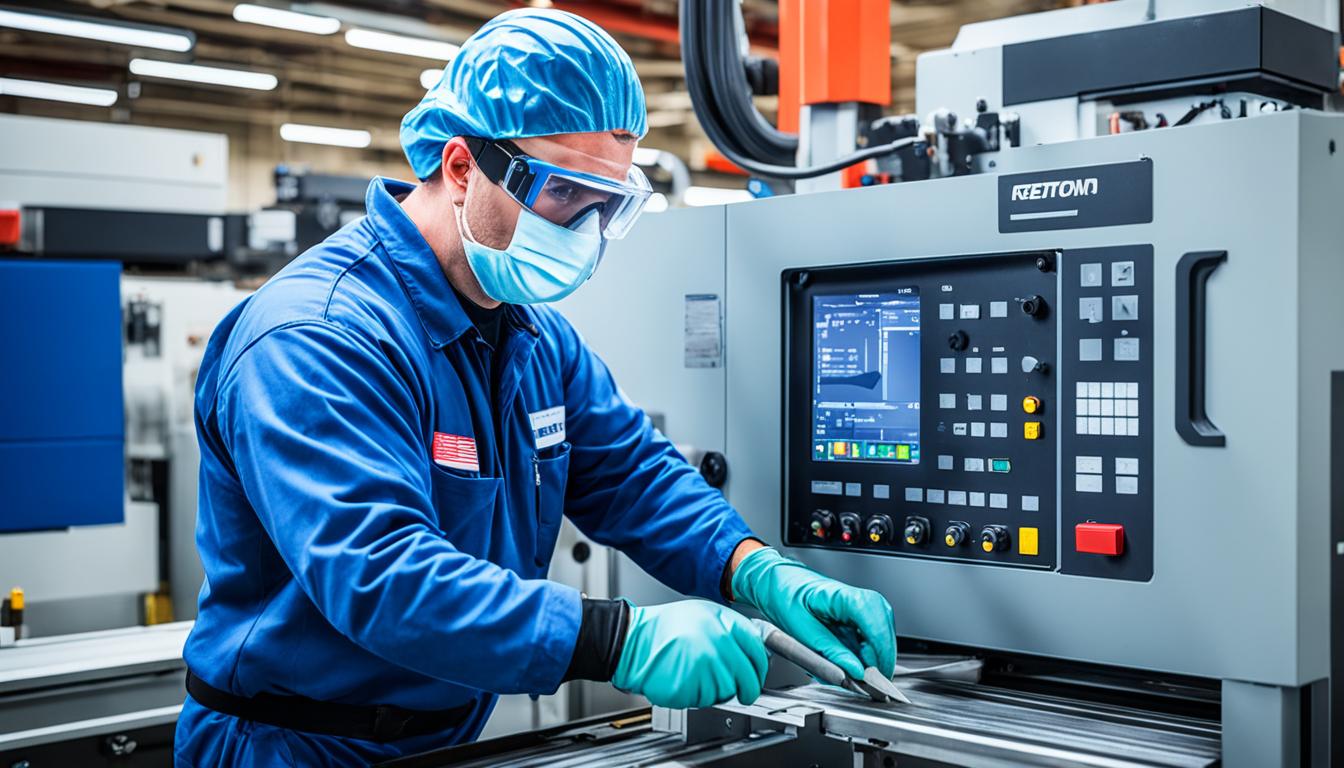
Operating Computer Numerical Control (CNC) machinery demands rigorous adherence to safety protocols to mitigate inherent risks. Modern CNC environments present hazards ranging from high-speed rotating components to airborne particulates and projectiles. Establishing and consistently enforcing advanced safety measures is paramount for protecting personnel and ensuring operational integrity.
OSHA 29 CFR 1910 Subpart O and the ANSI B11 series of standards provide foundational requirements for machine guarding, personal protective equipment (PPE), and operational safety in CNC machining. These regulations are critical for preventing common injuries such as lacerations from chips, entanglement in rotating parts, and impacts from ejected workpieces or tools.
Interlocked Enclosure Usage
Machine guarding is a primary safety control in CNC operations, with interlocked enclosures serving as a critical barrier. OSHA 29 CFR 1910.212 mandates that all machinery capable of causing injury must be guarded. For CNC turning centers, ANSI B11.22 specifically requires an enclosure that prevents access to the cutting zone during automatic cycle operation.
Modern CNC machines are typically equipped with full-enclosure guards and interlocked sliding doors. These interlocks prevent the machine from starting if a door is open and stop the spindle if a door is opened during operation. Defeating or bypassing an interlock is a serious violation of OSHA 29 CFR 1910.212 and ANSI B11 standards, regardless of the operator’s rationale.
Interlocked guards are essential where operators require periodic access for tasks like material loading or cleaning. The interlock must positively halt hazardous motion before access becomes possible. These systems should meet performance levels such as ISO 13849-1 PLd or PLe, often utilizing positively driven cam-operated switches.
Proper Eye and Ear PPE
| Mist Collector Type | Filtration Mechanism | Typical Application | Maintenance Considerations |
|---|---|---|---|
| Centrifugal | Centrifugal force separates mist from air | High-volume mist, some smoke | Minimal maintenance, may need HEPA for smoke |
| Media-Based | Multiple filtration stages (barrier technology) | Fine mist and smoke particles | Requires periodic filter replacement |
| Electrostatic Precipitator (ESP) | Electrically charges particles for collection on plates | Ultrafine mist and smoke | Maintenance is paramount for efficiency |
Personal Protective Equipment (PPE) forms a vital layer of defense against the hazards present in CNC machining environments. A thorough hazard assessment, as required by OSHA 29 CFR 1910.132, dictates the specific PPE necessary for each task.
Minimum eye protection for all personnel in a CNC machining area includes safety glasses with side shields, compliant with ANSI Z87.1. The ‘Z87+’ marking on eyewear indicates high-impact resistance, having passed rigorous high-velocity and high-mass impact tests. Flying chip hazards, even from tool breaks or workpiece ejection, can travel at high velocities across the shop floor.
Hearing protection is also critical, as CNC machining, particularly during heavy roughing, can generate sustained noise levels between 90-100 dB(A). OSHA 29 CFR 1910.95 mandates hearing protection when noise exposure exceeds 90 dB(A) as an 8-hour time-weighted average. At 100 dB(A), the permissible exposure time without protection drops to just two hours per shift.
Chip Hook Usage for Stringy Chips
Stringy chips, often produced when machining ductile materials like austenitic stainless steel or certain aluminum alloys, pose significant laceration and entanglement hazards. These chips can wrap aggressively around workpieces and tools, potentially catching clothing or dragging operators into rotating parts.
Operators must never manually grab or pull chips from an active machining operation. Instead, designated chip hooks or other appropriate tools should be used to clear chips, and only when the machine is in a safe, stopped condition. Cut-resistant gloves (ANSI/ISEA 105 Level A4 or higher) are recommended for handling chips away from rotating spindles.
Effective chip control begins with optimizing cutting parameters and tool geometry. Using inserts with built-in chip breaker profiles is the most reliable method to produce manageable, segmented chips. Adjusting spindle RPM and feed rates to increase cutting heat can also promote self-breaking chips.
Emergency Stop Function Checks
Emergency stop (E-stop) systems are fundamental safety devices designed to avert impending hazardous situations through immediate human intervention. Every CNC machine is equipped with one or more E-stop buttons, typically large red mushroom-head buttons, that instantly remove power from machine axes and the spindle.
All personnel working in the machine area must know the location and proper actuation of the E-stop on each machine. ISO 13850 specifies that the E-stop function must be available and operational at all times, overriding all operational modes without impairing other protective functions.
Regular verification and periodic testing of E-stop functions are mandatory. ISO 13850 and ISO 13849-1 require these tests at defined intervals. A typical annual test involves pressing each E-stop button, verifying that the safety relay disengages, the main contactor opens, and drive STO (Safe Torque Off) inputs de-energize. The stop time from actuation to drive enable loss should be measured and recorded, ideally targeting less than 50 ms.
Air Extraction for Dust/Mist
Maintaining clean air quality in a CNC machining environment is crucial for worker health and machine longevity. Machining processes often generate fine metallic particles, fluid aerosols, and coolant mist that can exceed permissible exposure limits (PELs) set by OSHA and recommended by NIOSH.
Coolant mist, formed when metalworking fluid atomizes during machining, poses risks of respiratory and skin diseases. NIOSH recommends limiting metalworking fluid aerosol exposures to 0.5 mg/m³ as a time-weighted average. Engineering controls, such as effective air extraction systems, are the primary method for reducing these exposures.
Mist collectors are essential for capturing airborne contaminants. These systems pull mist-laden air through a series of filters or electrostatic precipitators, removing particles before returning clean air to the workspace or exhausting it outdoors. Proper sizing is critical, often calculated by multiplying the machine enclosure volume by a factor of 2-6, depending on mist levels.
Critical installation requirements for mist collectors include positioning the capture hood within 6-12 inches of the mist generation point and sealing all enclosure penetrations. Maintaining negative pressure within the enclosure, verifiable with a smoke pencil test, ensures effective containment. Exhaust should be routed properly, either recirculated through HEPA filtration or vented outdoors with adequate clearance from air intakes.