
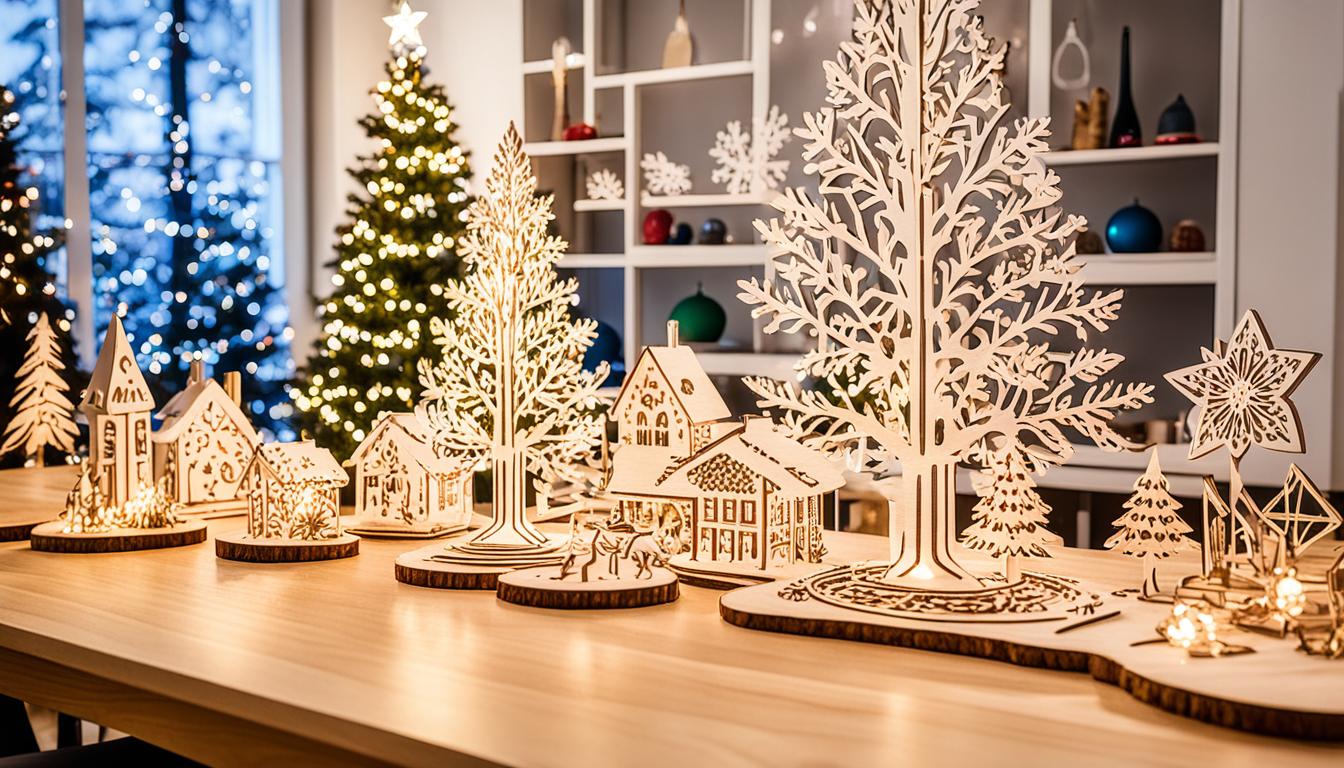
Computer Numerical Control (CNC) routers offer unparalleled precision and repeatability for crafting intricate holiday decorations and gifts. Leveraging these machines allows for rapid prototyping and batch production of custom festive items, transforming digital designs into tangible pieces with high accuracy. This technical guide explores various Christmas-themed projects, detailing material selection, tooling, and optimal machining parameters for superior results.
Crafting DIY Wooden Tree Ornaments
Producing wooden tree ornaments with a CNC router involves careful material selection and precise toolpath generation. Baltic Birch plywood, typically 1/8-inch (3mm) thick, is an excellent choice due to its stability and fine grain, which minimizes tear-out during intricate cuts. Hardwoods like maple, cherry, and walnut also yield crisp details and are less prone to chipping, though they require more robust machining parameters.
For cutting ornament profiles, a 1/8-inch (3.175mm) two-flute flat end mill is commonly employed. Optimal spindle speeds for hardwoods typically range from 18,000 to 20,000 RPM, with feed rates between 800-1000 mm/min (30-40 IPM) and a depth of cut (DOC) of 1.0-1.5mm per pass. For engraving fine details or personalized text, a 60-degree V-bit is ideal, operating at similar RPMs but with a slower feed rate, often around 1200 mm/min (40-50 IPM) and a maximum DOC of 2.5mm.
Workholding for small, thin materials like ornament blanks is critical to prevent movement and ensure cut quality. Double-sided tape, particularly specialized woodworking tape, provides a strong, residue-free hold. Alternatively, a combination of painter’s tape and CA glue can create a surprisingly robust bond, though care must be taken to prevent material bowing during machining.
Precision Carving for Nativity Scenes
| Material | Tool Type (Example) | Spindle Speed (RPM) | Feed Rate (IPM / mm/min) | Depth of Cut (DOC) | Notes |
|---|---|---|---|---|---|
| Hardwood (e.g., Maple, Walnut) | 1/8″ 2-Flute Flat End Mill | 18,000-20,000 | 30-40 IPM / 800-1000 mm/min | 1.0-1.5 mm | For profile cutting and pockets. |
| Hardwood (e.g., Maple, Walnut) | 60-Degree V-Bit | 18,000-20,000 | 40-50 IPM / 1000-1200 mm/min | 2.5 mm (max) | For engraving and V-carving. |
| Cast Acrylic | 1/4″ Single-Flute O-Flute End Mill | 18,000 | 75-300 IPM / 1900-7600 mm/min | 1/2 bit diameter | Minimize heat, ensure chip evacuation. |
| Cast Acrylic | 60-Degree Engraving Bit | 18,000 | Adjust for detail | Shallow | For fine engraving on acrylic. |
Creating detailed nativity scenes demands advanced 3D carving techniques and appropriate tooling. Hardwoods such as walnut and maple are preferred for their ability to hold fine detail and provide a rich aesthetic finish. Walnut, in particular, is favored for its balanced hardness and cooperative grain, making it suitable for hobbyist machines.
Roughing passes, which remove the bulk of material quickly, typically utilize larger flat end mills (e.g., 1/4-inch two-flute) with aggressive depths of cut, often 50% of the bit diameter or more, and higher feed rates (e.g., 140 IPM at 17,000 RPM in hardwood). This leaves a small ‘stock to leave’ for subsequent finishing passes. Finishing passes then employ smaller ball nose end mills (e.g., 1/8-inch or 1/16-inch) to achieve smooth contours and intricate details. These passes require significantly slower feed rates and shallower step-overs (e.g., 0.15mm for 1/8-inch ball nose) to minimize tool marks and achieve a superior surface finish.
For optimal surface quality, a finishing pass might run at 2060 mm/min (80 IPM) with an 1/8-inch ball end mill at 27,000 RPM, using a minimal stepover of 0.15mm. The goal is to create fine chips that carry heat away, preventing burning and ensuring crisp details. Post-machining, careful sanding, starting with grits around 120-180 and progressing to 220-320, is essential to remove any remaining tool marks and prepare the surface for staining or sealing.
Designing Custom Holiday Signage
Custom holiday signs, ranging from simple engraved plaques to multi-layered designs, benefit greatly from CNC precision. Materials like MDF, Baltic Birch plywood, and various hardwoods are popular choices. MDF offers a consistent surface for painting and engraving, while hardwoods provide natural beauty.
V-carving is a primary technique for lettering and decorative elements on signs. A 60-degree V-bit is a versatile tool for this, allowing for varying line widths based on cut depth. For a clean V-carve in hardwood, a spindle speed of 18,000 RPM and a feed rate of 1200 mm/min (47 IPM) with a maximum depth of 2.5mm is a good starting point. For deeper pockets or through-cuts, flat end mills are used, with parameters adjusted for material density.
Workholding for signs often involves clamps or screws, ensuring the material remains flat and secure across its surface. For larger signs, a vacuum table offers excellent hold-down force and full access to the workpiece, though it is less common on hobbyist machines. After machining, sanding and applying a suitable finish, such as paint, stain, or clear coat, will protect the sign and enhance its appearance.
Illuminated Layered Acrylic Light Boxes
Layered acrylic light boxes create a striking visual effect, with CNC routers excelling at cutting the precise layers. Cast acrylic is generally preferred over extruded acrylic for machining due to its superior tolerance capability and better surface finish, as it is less prone to melting and chipping. Standard tolerances for CNC machined acrylic are typically ±0.005 inches (±0.13mm) for general features, with precision tolerances reaching ±0.002 inches (±0.05mm) for critical interfaces.
For cutting acrylic, single-flute ‘O-flute’ end mills are highly recommended to efficiently evacuate chips and reduce heat buildup, which can cause melting and gumming. A 1/4-inch solid carbide O-flute bit is a common choice. Recommended spindle speeds for acrylic are around 18,000 RPM, with feed rates ranging from 75-300 IPM (1900-7600 mm/min). A good rule of thumb for cutting depth is half the bit’s diameter per pass. For engraving details, a 60-degree engraving bit at 18,000 RPM is effective.
Designing these light boxes requires consideration for LED strip integration. Channels for LEDs should be routed with appropriate dimensions to snugly fit the chosen lighting. Wall thickness for acrylic parts should generally be kept above 1.5-2mm to prevent stress fractures during machining or assembly. Ramping techniques for tool entry are also crucial to avoid fracturing the material.
Festive Gift Production
Producing a variety of festive gifts, from personalized cutting boards to engraved coasters, leverages the versatility of CNC machining. Material choices are broad, including various hardwoods for durability and aesthetic appeal, or acrylic for modern, illuminated designs. Precision in engraving and cutting ensures a high-quality finished product.
For personalized engravings on wood, a V-bit or a small diameter ball nose end mill (e.g., 1/16-inch) is used, with feeds and speeds adjusted for the specific wood hardness. For instance, a 1/8-inch two-flute flat end mill in hardwood might use 20,000 RPM and 1000 mm/min (40 IPM) feed rate with a 1.0mm DOC. When working with acrylic for gifts, such as custom keychains or small plaques, the same O-flute bits and parameters as for light boxes apply, focusing on chip evacuation to prevent melting.
Finishing processes are paramount for gift items. For wood, this includes thorough sanding to remove tool marks and achieve a smooth surface, followed by applying food-safe oils for cutting boards or durable lacquers for decorative items. Acrylic gifts often benefit from flame or vapor polishing to achieve optical-grade edges, though careful machining with proper tooling can minimize the need for extensive post-processing.