
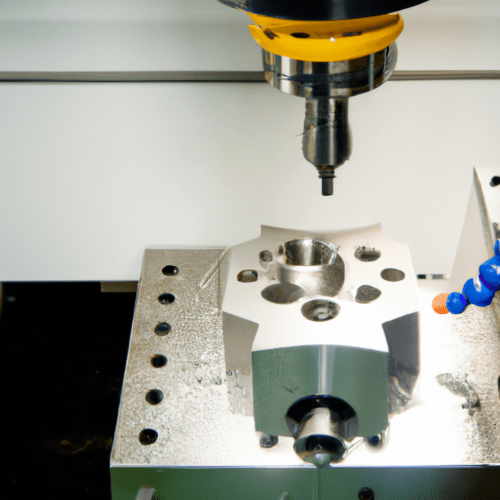
CNC machining is a cornerstone of modern aerospace manufacturing, enabling the creation of intricate components essential for space exploration. As humanity pushes further into the cosmos, the demand for parts that can withstand extreme conditions intensifies, making advanced machining techniques more critical than ever. This technology is indispensable for crafting components that brave the harshness of space, from scorching temperatures to the vacuum of deep space.
Machining Space-Grade Inconel Alloys
Inconel superalloys are fundamental to aerospace engineering, powering jet engines, turbine assemblies, and exhaust systems at temperatures exceeding 1,200°F where conventional alloys fail. Inconel 718, in particular, is widely used due to its age-hardenable microstructure, offering exceptional strength and creep resistance up to 1300°F, making it ideal for turbine discs and structural engine components. However, Inconel 718 scores only 12% on the AISI Machinability Index, presenting significant manufacturing challenges.
The primary difficulty in machining Inconel stems from its rapid work hardening, low thermal conductivity, and abrasive microstructure. Heat generated during cutting concentrates at the tool-workpiece interface, softening the carbide binder and accelerating tool wear. This necessitates specialized tooling and precise control over machining parameters to prevent catastrophic work hardening and ensure component integrity.
Aerospace Inconel components frequently require tight tolerances, often ±0.0002 inches or tighter on critical features, and surface finishes of 32 Ra or better. Achieving these specifications demands rigid machine setups, high-pressure coolant systems (500+ PSI), and continuous cutting to avoid work hardening from interrupted cuts. Carbide tools with TiAlN or AlTiN coatings are essential, with tool life typically limited to 20-40 minutes of actual cutting time.
*Note: These parameters are general guidelines for Inconel 718 and should be adjusted based on specific tool geometry, machine rigidity, and coolant delivery system.*
Precision Milling for Rocket Engine Nozzles
| Operation | Tool Type | Cutting Speed Vc (SFM) | Feed Rate (in/tooth or in/rev) | Depth of Cut ap (mm) |
|---|---|---|---|---|
| Rough Milling | Carbide end mills (TiAlN/AlTiN coated) | 60-100 | 0.003-0.006 in/tooth | 0.5-2.0 |
| Finish Milling | Carbide end mills (TiAlN/AlTiN coated) | 60-100 | 0.001-0.003 in/tooth | 0.2-1.0 |
| Rough Turning | Carbide (TiAlN coated) | 65-130 | 0.008-0.016 in/rev | 1.5-3.0 |
| Finish Turning | Carbide (PVD coated) | 30-80 | 0.002-0.008 in/rev | 0.2-1.0 |
Rocket engine nozzles are critical components that convert combustion gas thermal energy into directed kinetic energy, producing thrust. These nozzles must endure extreme heat, rapid temperature fluctuations, corrosive combustion products, and intense mechanical stresses. Materials like Niobium alloys (e.g., C-103), nickel-based superalloys, and carbon-carbon composites are commonly used due to their high melting points and thermal resistance.
Machining these materials for complex nozzle geometries, such as converging-diverging sections and cooling channels, demands exceptional precision. Niobium alloys, while offering good ductility, oxidize rapidly above 400°C, requiring protective coatings and careful machining environments. Superalloys like Inconel 718 and 625 are used in regeneratively cooled designs, often as liners for cooling channels.
Graphite and carbon-carbon (C/C) composites are frequently employed for throat inserts and liners in uncooled nozzles due to their very high sublimation temperatures and thermal shock resistance. Machining graphite generates fine dust, necessitating effective dust collection systems and lower RPMs to prevent spread. For cooled nozzles, high-thermal-conductivity copper alloys (e.g., CuCrZr, GRCop-84/42) are used for liners, with nickel-based superalloys forming the load-bearing shell.
Achieving Ultra-Lightweight Aerospace Components
Weight reduction is a paramount concern in aerospace manufacturing, directly impacting fuel efficiency, payload capacity, and maneuverability. CNC machining plays a pivotal role in achieving this ‘lightweighting’ by enabling the production of complex geometries from advanced materials with high strength-to-weight ratios. Materials such as titanium alloys, aluminum alloys, and carbon fiber composites are favored for their performance characteristics.
Modern CNC machines, particularly multi-axis centers, are crucial for crafting intricate parts like single-piece wing components without multiple setups, enhancing accuracy and reducing vibration. Topological optimization and the creation of lattice structures are advanced design strategies that, when combined with CNC machining, allow for significant material removal while maintaining structural integrity. This approach minimizes material volume while ensuring reliable load-bearing performance.
CNC machining excels at producing thin-walled parts and complex pocket patterns, which are essential for lightweight designs. Techniques like CNC Swiss machining are ideal for small-diameter, high-precision lightweight fasteners and thin-wall tubular components. The ability to hold tight tolerances on these delicate features is critical to prevent vibration and deformation that could compromise performance.
Manufacturing Challenges in Zero-Gravity Environments
Manufacturing in zero-gravity presents a unique set of challenges that fundamentally alter traditional CNC machining processes. Without gravity, securing tools and materials requires specialized anchoring systems to maintain precision and stability. Chip evacuation, a critical aspect of terrestrial machining, becomes problematic as chips do not fall away and can contaminate the environment or interfere with operations.
Heat dissipation is another significant hurdle in microgravity, as the absence of convection makes it harder to cool components, risking thermal stress or distortion. Innovative cooling solutions, relying on conduction and radiation, are necessary to prevent materials from overheating. Furthermore, machinery and materials must be designed to resist the harsh space conditions, including radiation and vacuum exposure.
While traditional subtractive manufacturing faces these obstacles, robotic machining systems are being developed for microgravity environments. These robots can cut, weld, and assemble parts with precision, offering autonomy and resilience for in-orbit repairs and fabrication. The integration of additive manufacturing (3D printing) with post-processing CNC machining is also a promising avenue for in-space production, allowing for on-demand part creation and reduced cargo needs.
Processing Extreme Temperature Alloys
Space exploration demands materials that can endure extreme temperatures, often exceeding 1,000°C. These extreme temperature alloys, including refractory metals like Niobium, Molybdenum, Tungsten, and Tantalum, along with ceramic matrix composites (CMCs), are vital for propulsion systems and re-entry vehicles. Their inherent toughness, high melting points, and resistance to wear make them exceptionally challenging to machine.
Refractory metals retain their strength and hardness at elevated temperatures, requiring more cutting force and leading to increased tool wear and breakage. Their low thermal diffusivity means heat concentrates at the cutting edge, further exacerbating tool degradation. Machining these materials often involves specialized techniques and tooling to achieve the desired surface finish and dimensional accuracy.
For example, Niobium alloys are used in smaller chemical rockets and space propulsion systems due to their high melting point and good ductility. However, they are difficult to machine, and additive manufacturing is being explored to produce complex and optimized components from these materials, though post-processing machining is still required. CMCs, consisting of carbon or ceramic fibers in a ceramic matrix, offer exceptional high-temperature resistance but are notoriously difficult to machine due to their hardness and abrasive nature.
The selection of cutting tools for these alloys is critical, often involving advanced carbide grades, ceramics, or CBN inserts, with specific coatings to resist heat and wear. Maintaining stable, rigid setups and employing high-pressure coolant systems are essential to manage heat and chip evacuation, ensuring precision and extending tool life.