
Precision manufacturing demands a highly skilled workforce capable of operating and programming sophisticated Computer Numerical Control (CNC) machinery. Educational institutions and industry partners are actively developing robust programs to meet this critical demand. These initiatives focus on practical application and theoretical understanding, ensuring the next generation of machinists is well-prepared for industry challenges.
STEM Shop Curricula Integration
Integrating CNC technology into Science, Technology, Engineering, and Mathematics (STEM) curricula provides students with hands-on, interdisciplinary learning experiences. This approach connects physics, mathematics, chemistry, and computer science through practical applications, fostering scientific and engineering thinking.
Curricula often begin with foundational principles, including blueprint reading, shop math, and precision measurement. Students learn about various materials, cutting tools, and essential machine safety protocols. Early exposure to these concepts builds a strong base for more complex CNC operations.
Many programs utilize project-based learning, allowing students to design and manufacture parts, thereby applying theoretical knowledge directly. This method enhances problem-solving skills and makes abstract concepts tangible. Such integrated learning environments are crucial for developing a comprehensive understanding of manufacturing processes.
Educational resources like Amatrol’s eLearning offer interactive modules, 3D simulations, and videos covering topics from machining and CNC to quality and safety. These self-paced materials allow educators to customize learning paths for different grade levels and classroom needs.
Modern Trade School Laboratory Environments
| Parameter | Typical Value / Range | Notes |
|---|---|---|
| Standard CNC Machining Tolerance (Metals) | ±0.005″ or ±0.127 mm | Achievable with conventional tooling for non-critical dimensions. |
| Precision CNC Machining Tolerance | ±0.001″ to ±0.002″ (±0.025 mm to ±0.05 mm) | Reliably held by standard milling and turning operations. |
| Cutting Speed (Vc) for 6061 Aluminum (Carbide End Mill) | 300-800 SFM (90-240 m/min) | Starting point for roughing is often 600 SFM, finishing 300-400 SFM. |
| Chip Load (fz) for 6061 Aluminum (Carbide End Mill) | 0.002″-0.005″ per tooth (0.05-0.15 mm/tooth) | Roughing typically 0.005″-0.008″, finishing 0.002″-0.003″. |
| Feed Rate (IPM) Calculation | RPM × Chips Per Tooth (CPT) × Number of Flutes | Ensures clean chip formation and prevents built-up edge. |
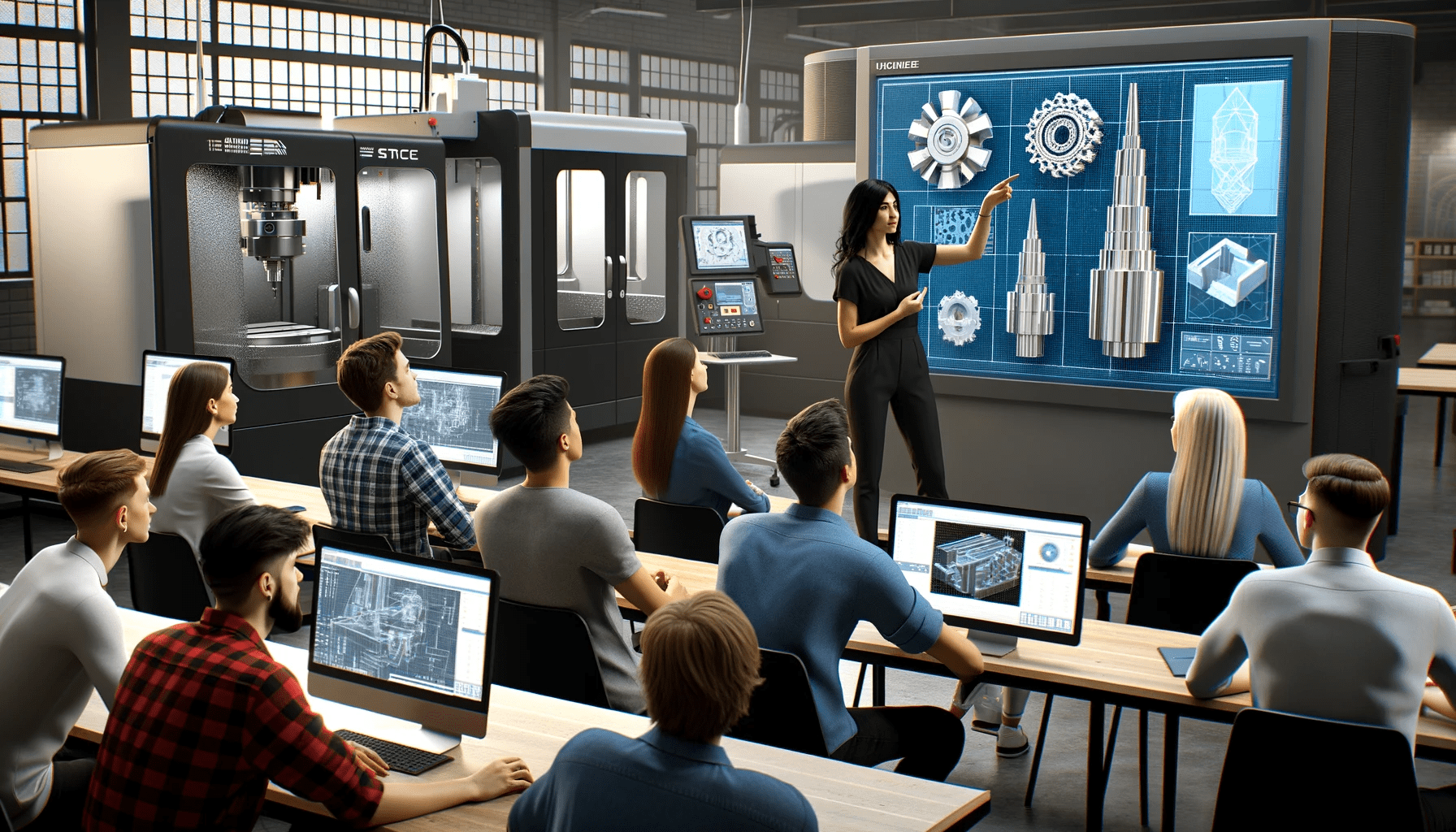
Contemporary trade school labs are equipped with industry-standard CNC machinery, mirroring the advanced manufacturing floors students will encounter professionally. These facilities often feature multi-axis milling and turning centers, alongside automation and simulation software.
Students gain experience on a range of equipment, from 3-axis mills and lathes to more complex 5-axis machines. Exposure to diverse CNC controls, such as Fanuc, Siemens, Heidenhain, and Haas, is also common, preparing them for various industrial settings.
Beyond machine operation, labs emphasize proper machine setup, tooling, and workholding techniques. Students learn to manage coolant levels, maintain machine cleanliness, and perform essential pre-operation checks. This practical training is vital for safe and efficient production.
Many programs also incorporate virtual labs and simulation software, allowing students to practice programming and test toolpaths without consuming material or machine time. This reduces errors and accelerates the learning curve before transitioning to physical machines.
Industry Certification Programs
Industry certifications validate a machinist’s skills and knowledge, providing a recognized credential for employers. The National Institute for Metalworking Skills (NIMS) offers widely recognized, skills-based credentials covering various aspects of machining.
NIMS certifications include ‘Measurement, Materials, & Safety’, ‘Job Planning, Benchwork, & Layout’, and specific ‘CNC Milling Operations’ and ‘CNC Turning Operations’ at Level 1. These credentials require both a written theory exam and a practical performance assessment.
Another prominent certification is the Haas CNC Certification Program, which provides online coursework on basic CNC machine operation, safety, and fundamental machining processes. Completion of the online modules is followed by a required in-person, hands-on final exam at a local Haas Factory Outlet.
These certifications are crucial for career progression, demonstrating proficiency in CNC fundamentals, safety, setup, and machine operation. Employers often prioritize candidates with NIMS credentials and hands-on experience on platforms like Haas or Mazak.
Apprenticeship Models for Skill Development
Apprenticeship models offer a structured pathway for individuals to gain comprehensive CNC machining skills through a blend of paid on-the-job training and related classroom instruction. These programs are recognized nationwide and meet rigorous industry standards.
Employers benefit significantly from apprenticeships by developing a highly skilled workforce tailored to their specific operational needs. Apprentices learn company culture and specialized processes, leading to improved productivity and reduced turnover.
Apprenticeships typically span several years, covering a broad range of skills from foundational machining to advanced CNC programming and multi-axis operations. This comprehensive training ensures apprentices are well-rounded and adaptable to evolving manufacturing technologies.
Many programs are registered with the U.S. Department of Labor, signifying adherence to national quality standards and providing apprentices with a portable credential. This structured approach helps address the manufacturing skills gap effectively.
Hands-On CAM Learning
Practical application of Computer-Aided Manufacturing (CAM) software is fundamental for modern CNC machinists. Hands-on learning involves generating toolpaths, simulating machining processes, and understanding post-processing for various CNC machines.
Students learn to translate 3D CAD models into machine-readable G-code, optimizing cutting strategies for efficiency and surface finish. Popular CAM software used in educational and industrial settings includes Mastercam, Autodesk Fusion 360, and SolidWorks CAM.
Training typically covers adaptive roughing, morph toolpaths, and real-time collision avoidance for multi-axis setups. The ability to analyze geometry and suggest automated toolpath strategies, often with AI-enabled features, is becoming increasingly important.
Effective CAM training emphasizes a mix of theory and practice, allowing learners to apply concepts immediately. Resources like free learning editions, online tutorials, and project-based exercises are invaluable for developing proficiency.