
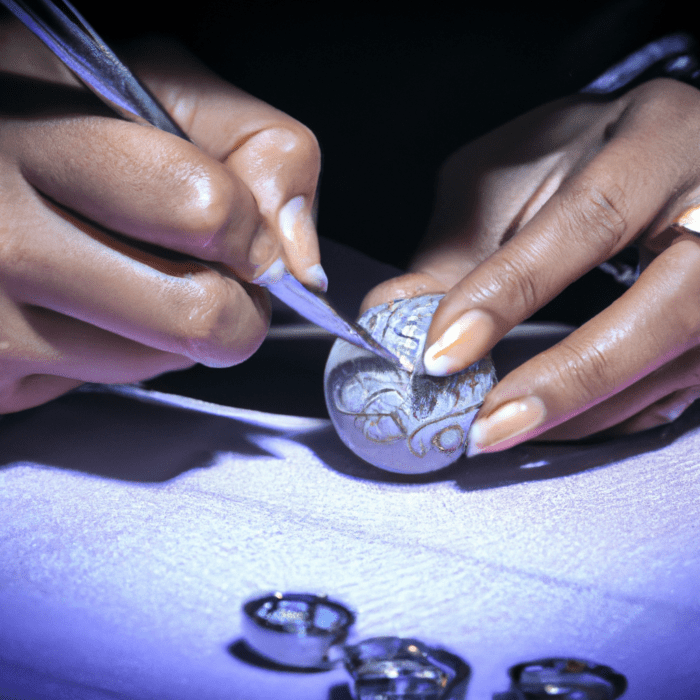
Computer Numerical Control (CNC) machining offers unparalleled precision for jewelry manufacturing, enabling the creation of intricate designs previously unattainable through traditional methods. This subtractive manufacturing process utilizes high-speed rotary cutting tools to remove material from solid blocks of wax or metal, guided by precise digital instructions. The technology provides consistent accuracy, which is critical for repeatable production and complex geometries in fine jewelry.
CNC technology is particularly advantageous for materials like stainless steel, titanium, and tungsten, which are challenging to cast cleanly due to their hardness. It ensures zero porosity and allows for tight tolerances, making it an ideal solution for structured, geometric designs at a wholesale level.
CNC Wax Carving for Investment Casting
Wax carving for investment casting is a foundational application of CNC in jewelry making. This process involves milling a detailed wax master pattern, which is then used in the lost wax casting method to produce the final metal piece. This technique is excellent for complex silver or gold designs where casting remains the preferred manufacturing route.
Specialized modeling waxes are used for CNC carving, offering properties that facilitate intricate detailing and smooth surface finishes. These waxes are forgiving materials, allowing for a wide range of spindle speeds and feed rates. Typical spindle speeds for wax can range from 3500 RPM to 5000 RPM, with feed rates between 15 and 20 inches per minute (ipm).
Maintaining appropriate depth of cut (DOC) is crucial to prevent damage to the machine’s spindle bearings, especially with smaller mills. For instance, a 1/8-inch end mill might use a DOC of 0.0625 inches in wax, while a 1/4-inch end mill could handle 0.125 inches.
Tolerances for ‘lost wax model’ castings are often governed by international norms like VDG P690, with Class D1 considered standard. Achieving extremely precise tolerances, such as Class D3, is feasible for limited dimensions and surfaces, but can increase production costs.
Achieving Precision with Micro Milling Techniques
| Parameter | Wax (General) | Silver (Micro Milling) | Precious Metals (General) |
|---|---|---|---|
| Spindle Speed (RPM) | 3500 – 5000 | ~9000 – 10000 | Varies, often high for carbide |
| Feed Rate (IPM) | 15 – 20 | ~3 – 30 (slow for finish) | Adjusted for chip load and material |
| Depth of Cut (DOC) | 0.025″ – 0.125″ (tool dependent) | ~0.01″ – 0.05mm (very shallow) | Small, especially for finishing |
| End Mill Material | HSS or Carbide | Carbide | Carbide (often coated) |
| Standard Tolerance | VDG P690 Class D1 (for casting) | ±0.025 mm (±0.001 in) to ±0.01 mm (high-precision) | ±0.025 mm (±0.001 in) |
| Surface Finish (Ra) | Smooth for casting | 0.4 – 1.6 µm (16 – 63 µin) for fine finish | 0.4 – 1.6 µm (16 – 63 µin) for fine finish |
Precision micro milling is essential for creating the minute details characteristic of fine jewelry. This involves using very small and delicate tools on high-frequency machining spindles, ensuring process-reliable machining even with tools as small as 0.2mm to 0.6mm in diameter.
Machines like the Mira 6S, a 5-axis CNC mill, offer sub-micron resolution (0.3 microns or 0.0003 mm), enabling the milling of jewelry molds with microscopic details and achieving glossy surface finishes. These advanced systems often incorporate ‘Smart Angular Movements Control’ to reduce milling time and enhance efficiency.
Workholding rigidity is paramount in micro milling to prevent tool deflection and breakage. Utilizing shrink-fit or press-fit tool holders and maximizing shank contact with the collet while minimizing tool stick-out are critical practices.
Standard CNC machining typically achieves tolerances around ±0.005 inches (0.127 mm) for most linear dimensions. For high-precision applications, tolerances can be tightened to ±0.001 inches (0.025 mm) or even ±0.0005 inches (0.0127 mm) for reamed holes.
Machining Precious Metals for Fine Jewelry
Direct machining of precious metals like gold, silver, and platinum presents unique challenges due to their material properties. Silver, for instance, can be prone to burr formation if feed rates are too high, and cutting temperatures must be managed to avoid galling.
Carbide end mills are generally preferred for machining harder materials, including precious metals, due to their durability and ability to withstand high speeds. Coatings like AlTiN can further enhance wear resistance and reduce friction, allowing for higher cutting speeds and feeds.
For silver, a slow feed rate of approximately 3 ipm with a 0.01-inch depth of cut at 10,000 RPM has been suggested to minimize burring. Using an air blast for chip evacuation is also beneficial, and coolant can significantly improve surface finish and allow for faster cutting.
Achieving a high-quality surface finish is crucial for jewelry. While a standard ‘as-machined’ finish might be around 3.2 µm Ra (125 µin), finer finishes of 1.6, 0.8, or 0.4 µm Ra (63, 32, or 16 µin) are achievable with additional finishing passes.
CAD Software for Jewelry Design and CAM
Computer-Aided Design (CAD) software is the initial and most critical step in CNC jewelry manufacturing, as all CNC work begins with a precise 3D CAD file. These files serve as a complete blueprint, defining all dimensions, boundaries, and intricate features before any material is cut.
Jewelry-specific CAD systems like RhinoGold, MatrixGold, 3Design, and JewelCAD are purpose-built for the unique workflows of jewelers. General-purpose 3D and CAD tools such as Fusion 360 and Rhino also offer powerful modeling capabilities, especially when augmented with jewelry-specific plugins.
For organic or sculpted forms, tools like ZBrush are often employed, though files from sculpting software may require ‘retopology’ to be production-ready for CNC. Free options like Blender, FreeCAD, and Tinkercad are suitable for concepting and hobbyist work.
Common file formats for CNC jewelry manufacturing include STEP and 3DM, which preserve precise surface geometry for machining and traditional casting. For direct 3D printing, STL files at high resolution are standard, though they represent objects as a mesh of triangles and do not store mathematical surface data.
Optimizing Small Diameter End Mill Performance
Small diameter end mills, typically defined as those under 1/8 inch (3mm), are indispensable for intricate jewelry details. These tools are considerably weaker than their larger counterparts, necessitating careful optimization of machining parameters.
Carbide is the most common material for these end mills, offering longevity and performance at high speeds. Coatings such as AlTiN or FX7 enhance wear resistance and reduce friction, crucial for extending tool life in precision applications.
Minimizing tool runout is paramount for small diameter end mills, as excessive runout (ideally not exceeding 2% of the tool diameter) leads to poor surface finish and premature tool breakage. Runout causes uneven chip loads, where some flutes are overloaded while others rub, accelerating wear.
Proper feeds and speeds are critical; a feed rate that is too high can lead to excessive chip load and tool snapping, while a feed rate that is too slow can cause the tool to rub instead of cut, generating heat. Chip evacuation is also vital, often managed with compressed air or high-pressure coolant, especially in deep cavities.