
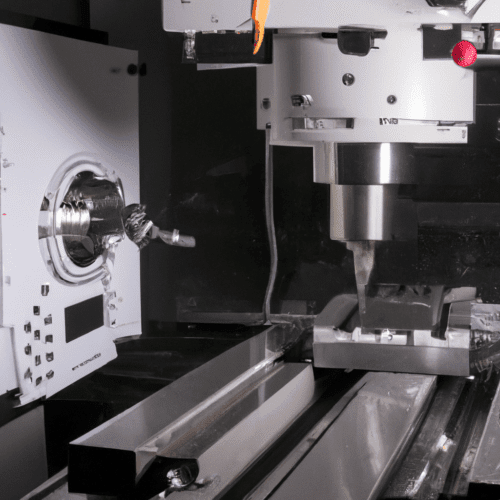
Computer Numerical Control (CNC) machines represent a fundamental shift in manufacturing, transforming raw materials into precisely engineered components through automated processes. These sophisticated systems integrate computer technology with machine tools, enabling unparalleled accuracy and repeatability in production.
CNC technology has largely replaced older numerical control (NC) systems, which relied on data storage media like punched cards. The ease of programming, modification, and real-time adjustments offered by CNC systems proved superior as computing costs decreased.
Understanding the Core of CNC Machining
At its heart, a CNC machine is an automated computer machine tool, where pre-programmed software and codes dictate the exact movements and tasks to be completed. This computerized operation eliminates the need for manual control, significantly improving consistency and accuracy in production.
Instructions are delivered to a CNC machine primarily through G-code and M-code, forming a sequential program of machine control instructions. G-code, or ‘geometric code,’ specifically dictates the tool’s movement, including its start and stop points, path, feed rate, and the shape it creates.
M-codes, or ‘miscellaneous codes,’ manage non-geometric machine functions such as spindle activation, coolant flow, and tool changes. Together, G-code and M-code translate a digital model into precise physical actions, forming the backbone of CNC programming.
The Mechanics of Subtractive Manufacturing
| Tolerance Class (ISO 2768-1) | Linear Dimension Range (mm) | Tolerance (mm) |
|---|---|---|
| Fine (f) | 0.5 to 3 | ±0.05 |
| Medium (m) | 0.5 to 3 | ±0.1 |
| Coarse (c) | 0.5 to 3 | ±0.2 |
| Very Coarse (v) | 0.5 to 3 | ±0.4 |
CNC machines are fundamentally multi-axis subtractive machines, meaning they create parts by progressively removing material from a larger workpiece. This process is suitable for a wide array of materials, including metals, plastics, wood, and composites.
While 3-axis machines move along the X, Y, and Z linear axes, multi-axis machines introduce additional rotational axes, allowing for more complex movements and intricate geometries. Common configurations include 4-axis and 5-axis machines, with some advanced systems offering up to 7, 9, or even 12 axes.
Multi-axis machining enhances part accuracy, optimizes the production of complex shapes, and can extend tool lifespan by maintaining optimal cutting positions. It also reduces the need for multiple fixture setups, leading to lower labor costs and less material waste.
Precision and Tolerances in CNC Operations
Precision metal and wood cutting is a hallmark of CNC technology, with machines capable of achieving extremely tight tolerances. This precision is critical for parts that require exact fits within assemblies, ensuring reliability and safety.
Standard tolerances in CNC machining are often governed by international standards like ISO 2768. This standard provides general metric tolerances for linear and angular dimensions without individual tolerance indications, simplifying drawings and ensuring global consistency.
ISO 2768 is divided into two parts: Part 1 defines general tolerances for linear and angular dimensions across four classes (fine, medium, coarse, very coarse), while Part 2 addresses geometrical tolerances for features like flatness and straightness.
Typical precision CNC machining can achieve tolerances within ±0.005 mm, with high-end machines reaching ±0.002 mm. Some ultra-precision applications, particularly in aerospace and medical industries, demand tolerances as narrow as 1 to 5 microns.
Modern Applications and Factory Integration
Modern factory equipment heavily relies on CNC machines for their enhanced accuracy, increased production speed, and reduced human error. These machines can operate continuously, maximizing productivity and meeting high-volume demands across various industries.
CNC technology is integral to sectors such as aerospace (turbine blades, engine parts), automotive (engine and transmission components), consumer electronics (housings, connectors), and medical devices (implants). Their versatility allows them to work with diverse materials and adapt quickly to design changes.
Optimizing ‘feeds and speeds’ is crucial for efficient CNC operation, impacting chip formation, tool life, and surface finish. For 6061 aluminum, typical cutting speeds for carbide end mills range from 300-1200 m/min, with chip loads between 0.05-0.15 mm/tooth.
When machining 304 stainless steel, carbide tooling generally requires cutting speeds of 150-220 m/min for turning and 60-75 m/min for milling, with lighter chip loads to prevent work hardening and ensure tool longevity.
Key Components and Control Systems
A CNC machine comprises several key components that work in concert. These include the cutting tool, which performs the material removal, and a motorized maneuverable platform or spindle that moves the tool or workpiece along specified axes.
The control system, driven by G-code and M-code, translates digital designs from CAD/CAM software into precise machine movements. This feedback loop between the machine’s moving components and the controller is vital for maintaining positioning accuracy.
Modern CNC machines often feature automatic tool changers, allowing for a wide range of operations without manual intervention. Advanced systems also incorporate feedback loops that continuously monitor tool position and speed, enabling real-time adjustments for enhanced precision.