
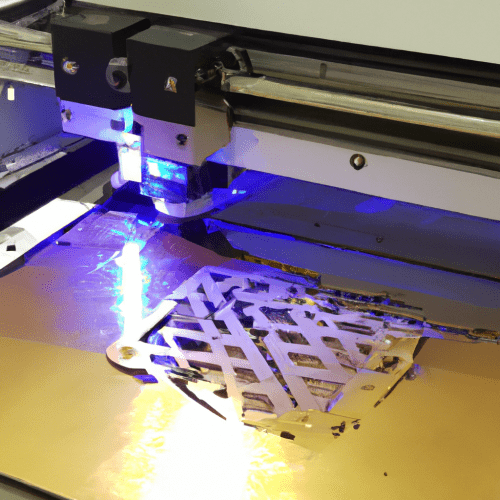
Laser cutting technology provides unparalleled precision and efficiency across a broad spectrum of manufacturing applications. These machines utilize a focused laser beam to melt, burn, or vaporize material, creating highly accurate cuts and intricate designs. The non-contact nature of laser processing minimizes material distortion and tool wear, making it ideal for both delicate and robust materials.
Modern laser systems, encompassing CO2, fiber, and UV lasers, are integral to industries ranging from aerospace to consumer goods. Each laser type offers distinct advantages in terms of wavelength, power output, and material compatibility. Selecting the appropriate laser system is critical for optimizing performance and achieving desired material processing outcomes.
Precision Vector Cutting
Precision vector cutting involves tracing a defined path, or vector, with a highly focused laser beam to achieve clean, accurate cuts through various materials. This method is fundamental for producing parts with tight tolerances and complex geometries. The laser’s kerf, or cut width, is a critical parameter, typically ranging from 0.05 mm to 0.5 mm depending on the material, thickness, and laser type.
Achieving optimal precision requires careful calibration of laser power, cutting speed, and assist gas pressure. For instance, cutting 3mm acrylic often uses a CO2 laser at 60-80W, with speeds between 10-25 mm/s and low air assist to prevent scorching. Standard tolerances for laser-cut parts can be as tight as ±0.05 mm to ±0.1 mm for thinner materials, increasing slightly with material thickness.
Material selection significantly impacts cutting parameters and achievable precision. Plywood, for example, requires different power and speed settings than acrylic due to its layered structure and varying density. Engineers must consider material composition, thermal properties, and desired edge quality when programming vector cuts.
Laser Raster Engraving
| Parameter | CO2 Laser (Acrylic) | Fiber Laser (Mild Steel) |
|---|---|---|
| Material Thickness | 3mm – 25mm | 0.5mm – 30mm |
| Typical Power Range | 40W – 400W | 1kW – 20kW+ |
| Cutting Speed (3mm) | 10-25 mm/s | >100 mm/s |
| Achievable Tolerance | ±0.05mm – ±0.1mm | ±0.05mm – ±0.15mm |
| Assist Gas | Air (low pressure) | Oxygen or Nitrogen |
Laser raster engraving creates images and patterns by scanning the laser beam back and forth across a surface, similar to how an inkjet printer operates. The laser fires pulses at varying intensities, burning or ablating material to create depth and tonal variations. This technique is widely used for marking, branding, and adding decorative elements to products.
Resolution in raster engraving is measured in dots per inch (DPI), with common settings ranging from 200 to 1000 DPI. Higher DPI settings produce finer details but increase processing time. Grayscale engraving is achieved by modulating laser power, where darker areas receive more laser energy and lighter areas receive less, creating a gradient effect.
Engraving speeds and power settings are highly material-dependent. For wood, a CO2 laser might engrave at 200-400 mm/s with 20-40% power for a light mark, while anodized aluminum requires higher power and slower speeds, often 50-150 mm/s at 60-80% power, to achieve a clear, permanent mark. Proper focus is paramount to prevent blurring and ensure crisp image reproduction.
Acrylic Edge Polishing
Laser cutting acrylic can produce a ‘flame polished’ edge directly from the machine, eliminating the need for secondary finishing operations. This occurs when the laser’s heat melts the acrylic along the cut line, resulting in a smooth, clear, and glossy finish. Achieving this quality depends heavily on precise laser parameters and material properties.
Optimal settings for clear acrylic edge polishing typically involve a CO2 laser with sufficient power (e.g., 80-150W for 6mm acrylic) and a relatively slow cutting speed (e.g., 5-15 mm/s). Low air assist is crucial to prevent cooling the molten edge too quickly, which can lead to a frosted or cloudy appearance. Excessive air assist can also introduce striations or ‘chatter marks’ on the edge.
Material quality, specifically cast acrylic, generally yields superior polished edges compared to extruded acrylic, which can sometimes show internal stress lines or bubbles when laser cut. Maintaining a clean lens and proper beam alignment are also essential for consistent edge quality across the entire cut path.
Prototyping Enclosure Boxes
Laser cutters are indispensable tools for rapid prototyping of enclosure boxes, allowing engineers to quickly iterate designs and test form, fit, and function. Materials like acrylic, plywood, and MDF are commonly used due to their ease of cutting and cost-effectiveness. Complex designs with interlocking features can be produced in minutes or hours, not days.
Designing for laser-cut enclosures often involves finger joints or tab-and-slot constructions to facilitate assembly without fasteners. The ‘kerf compensation’ feature in CAD/CAM software is vital to ensure a snug fit for interlocking parts, adjusting for the material removed by the laser beam. Typical material thicknesses range from 3mm to 6mm for most prototypes.
Engineers frequently utilize parametric design software to generate adaptable enclosure models. This allows for quick modifications to dimensions, port cutouts, and mounting points. The ability to produce accurate, repeatable parts makes laser cutting ideal for low-volume production runs and custom one-off enclosures.
Industrial Sheet Metal Cutting
Industrial laser cutting, predominantly using high-power fiber lasers, has revolutionized sheet metal fabrication. These systems offer exceptional speed, precision, and versatility for cutting various metals, including mild steel, stainless steel, aluminum, and copper alloys. Fiber lasers are particularly efficient due to their high beam quality and excellent absorption characteristics in metals.
Cutting capabilities vary significantly with laser power and material type. A 6kW fiber laser can cut mild steel up to 25mm thick and stainless steel up to 20mm thick, while a 12kW system can extend these capabilities to 30mm and 25mm respectively. Assist gases play a critical role in the cutting process, with oxygen used for mild steel to facilitate an exothermic reaction, and nitrogen used for stainless steel and aluminum to produce dross-free, oxide-free edges.
Typical industrial laser cutting speeds for 3mm mild steel with a 6kW fiber laser can exceed 100 mm/s, while 3mm stainless steel with nitrogen assist might be cut at 60-80 mm/s. Edge quality is paramount in industrial applications, with fiber lasers consistently delivering smooth, perpendicular cuts with minimal heat-affected zones. This reduces the need for secondary finishing, streamlining production workflows.