
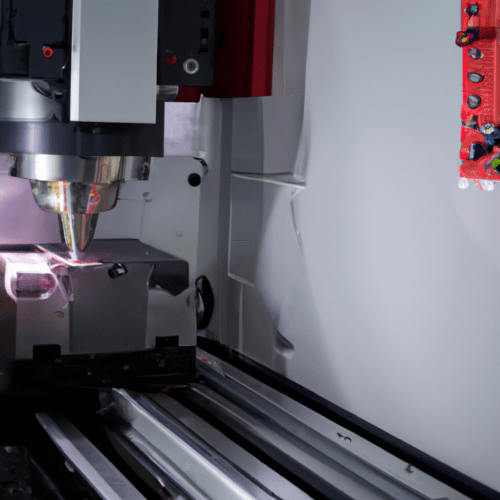
The manufacturing sector is undergoing a profound transformation, driven by advancements in automation, artificial intelligence, and computational power. CNC machining, a cornerstone of modern production, is at the forefront of this shift, moving towards unprecedented levels of autonomy and precision. This evolution promises to redefine efficiency, cost-effectiveness, and the very nature of human involvement in the production process.
As of 2026, the integration of smart factory systems and digitalization is rapidly accelerating the capabilities of precision CNC machining. Manufacturers are increasingly deploying robotic loading and unloading systems, automated pallet changers, and ‘lights-out’ machining routines. These innovations are designed to minimize human intervention, reduce errors, and significantly decrease downtime, allowing skilled personnel to focus on oversight and optimization rather than direct operation.
Fully Autonomous Machine Shops
The concept of fully autonomous machine shops, once a futuristic vision, is rapidly becoming a tangible reality. These facilities operate with minimal to no human presence, leveraging advanced robotics, IoT sensors, and sophisticated software to manage the entire production lifecycle. Gartner estimates that by 2026, 60% of manufacturers will adopt some form of lights-out manufacturing, indicating its rapid move into the mainstream.
Leading examples already exist, such as FANUC’s factory in Japan, which has been building robots autonomously since 2001, operating for 30 days straight without human intervention. Siemens’ Amberg plant also achieves exceptional quality rates of 99.99% with minimal human oversight. These ‘dark factories’ demonstrate continuous, unmanned production supported by smart scheduling and remote monitoring.
Achieving full autonomy requires a robust ‘sense-decide-act’ loop. IoT sensors continuously monitor parameters like temperature, vibration, and quality in real-time. AI systems then analyze this data to make autonomous optimization decisions, while robots and integrated systems execute tasks and self-correct automatically. This comprehensive integration is crucial for maintaining consistent output and quality in an unattended environment.
Cloud CAM Toolpath Generation
| Feature | Classical Computing | Quantum Computing (Hybrid) |
|---|---|---|
| Problem Complexity | Struggles with NP-hard combinatorial problems at scale. | Potential for exponential speedup on specific optimization tasks. |
| Solution Time | Can take significant time for large, complex instances; may find near-optimal solutions. | Aims to find optimal solutions faster for specific problem types. |
| Current Application | Widely used for most scheduling, proven optimal for smaller instances. | Emerging for complex optimization, often in hybrid workflows. |
| Hardware Requirements | Standard CPUs and GPUs. | Specialized quantum processors, often integrated with classical systems. |
Cloud-based CAM toolpath generation is revolutionizing how machining strategies are developed and deployed, offering enhanced accessibility, collaboration, and computational power. Unlike traditional on-premises solutions, cloud CAM allows users to access design, simulation, and manufacturing data from any internet-connected device, facilitating remote collaboration across geographically dispersed teams.
This approach provides automatic software updates and seamless integration with other cloud-based tools, ensuring manufacturers always have access to the latest features and functionalities, including AI and machine learning capabilities. CloudNC’s ‘CAM Assist’ is an example, integrating as a plugin into platforms like Fusion 360 and Mastercam to generate complete machining strategies using AI.
AI-driven CAM software, such as CloudNC’s offering, can generate machining strategies, tooling selections, feeds, speeds, and toolpath sequencing that programmers review and approve, rather than building from scratch. This significantly accelerates programming time and quoting processes, especially for 3+2 axis workflows, which constitute a large portion of the CNC machining market.
Quantum Computing Optimization
Quantum computing is emerging as a disruptive technology with the potential to solve complex optimization problems in manufacturing that are currently intractable for classical computers. By harnessing quantum mechanical principles like superposition and entanglement, quantum computers can process data in ways that offer exponential speedups for certain problem classes.
In manufacturing, quantum optimization can significantly improve production scheduling, supply chain efficiency, and resource allocation. These complex combinatorial optimization problems, such as job-shop scheduling, are notoriously difficult for classical algorithms to solve optimally within practical timeframes. Quantum-powered optimization can help forecast demand more accurately and synchronize production with market needs, reducing lead times and minimizing inventory costs.
While fully fault-tolerant quantum computers are still in development, hybrid quantum-classical workflows are expected to see widespread use by 2026. These setups combine quantum processors for specific, computationally intensive optimization tasks with classical computers handling the surrounding workload, offering measurable performance improvements in areas like logistics and manufacturing.
Zero-Human Operation
The drive towards zero-human operation in manufacturing is a natural extension of automation and AI integration, aiming for ‘lights-out’ factories where production runs continuously without direct human intervention. This paradigm shifts human roles from direct machine operation to supervisory, maintenance, and strategic planning functions.
Predictive maintenance, powered by AI and IoT sensors, is a cornerstone of zero-human operation. Systems continuously monitor critical CNC components like spindles, motors, and cutting tools, identifying potential failures before they occur. This proactive approach significantly reduces unplanned downtime and extends equipment life.
AI models can detect micro-changes in vibration, temperature, and power draw, forecasting failures up to 72 hours in advance with high confidence, often around 94% accuracy after six months of learning. This allows for scheduled maintenance during planned downtime, preventing catastrophic breakdowns and reducing maintenance costs by an average of 25%.
Ultra-Precise Nano-Machining
The frontier of manufacturing precision is extending into the nanometer scale, enabling the creation of components with unprecedented accuracy for advanced applications. Ultra-precise nano-machining involves specialized techniques to achieve tolerances far beyond conventional CNC capabilities, which typically range from ±0.05 mm to ±0.13 mm.
Achieving precision-grade tolerances of ±0.01 mm requires specialized equipment, careful process control, and experienced operators. For aerospace and medical-grade components, tolerances can be as tight as ±0.002-0.005 mm. These extreme levels of precision are critical for industries like semiconductors, optics, and medical devices.
Technologies enabling nano-machining include focused ion beam (FIB) milling, advanced electrical discharge machining (EDM), and atomic layer deposition (ALD). These methods allow for material removal and deposition at atomic or near-atomic scales, creating intricate geometries and ultra-smooth surfaces essential for next-generation products.
- Standard commercial CNC tolerance: ±0.05 mm (±0.002″)
- Precision grade CNC tolerance: ±0.01 mm (±0.0004″)
- Ultra-high precision CNC tolerance: ±0.005 mm (±0.0002″)
- Aerospace/medical grade CNC tolerance: ±0.002-0.005 mm