
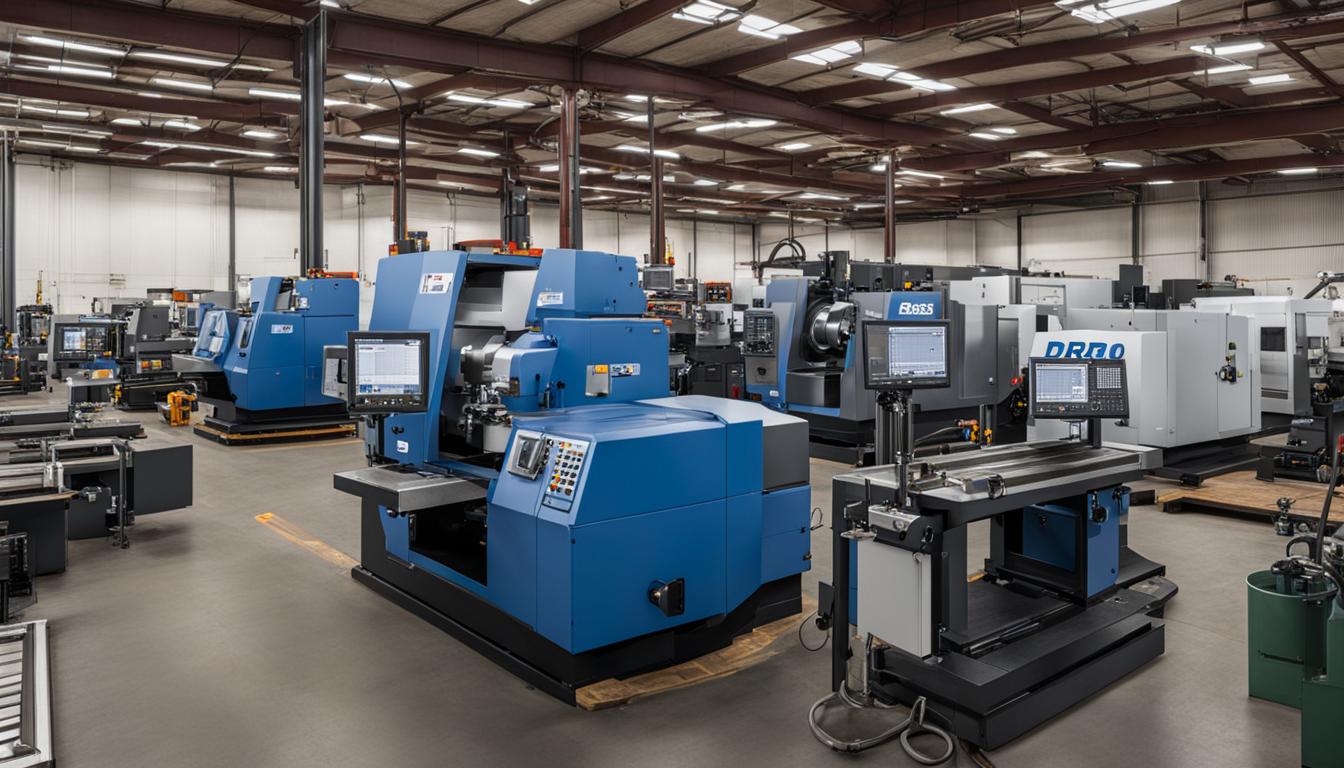
Digital Readout (DRO) systems are electronic position-display tools that significantly enhance the precision and efficiency of manual machine tools. These systems provide real-time feedback on the exact position of a machine’s axes, eliminating reliance on traditional, less accurate methods like counting handwheel revolutions or reading Vernier dials.
A complete DRO system typically comprises linear encoder scales, which measure movement along each axis, and a display console that processes and presents this data numerically. This technological upgrade is widely considered one of the most impactful improvements for manual milling machines, lathes, and grinders.
Optical Glass Linear Scales: the Core of Precision
Optical glass linear scales are fundamental components of many high-precision DRO systems, acting as the ‘eyes’ that meticulously track machine movement. These scales consist of precision-etched glass strips with microscopic lines, which an optical sensor ‘reads’ as the machine axis moves.
The working principle involves a light source, often an LED, passing through these grating lines, creating an interference phenomenon detected by photodetectors. This photoelectric process generates precise digital position readings, converting physical displacement into electronic signals.
Optical linear scales offer resolutions as fine as 0.5 microns, 1 micron, and 5 microns, with 5µm (0.0002″/0.005mm) being a common and highly effective choice for milling machines and lathe carriages. Their stability in size, shape, and density makes them ideal for precision applications, though they require protection from coolant and debris.
Real-Time Position Display Screen
| Feature | Description |
|---|---|
| Axis Display | 2, 3, or 4 axes (X, Y, Z, W) |
| Resolution | Typically 0.1µm to 50µm, commonly 5µm or 1µm |
| Unit Conversion | Seamless switching between inch and metric units |
| Zeroing/Preset | Instant reference point setting and quick jumps to predefined locations |
| Advanced Functions | Bolt-hole circles, linear pattern spacing, tool offset libraries (on some models) |
The processing and display unit, often referred to as the DRO’s ‘digital brain,’ translates raw data from the linear encoders into user-friendly readings shown on a digital screen. Modern DROs feature sophisticated displays, ranging from 7-segment LED readouts to advanced LCD or true-color LCD screens.
These displays offer simultaneous viewing of multiple axes (X, Y, Z, and sometimes more), along with essential functions like zeroing, preset positions, and unit conversion between metric and imperial measurements. Some contemporary units even include drawing functions, allowing operators to preview machined effects and display the tool’s current position relative to a saved drawing.
Eliminating Manual Backlash Errors
Manual machine tools inherently suffer from mechanical inaccuracies, most notably ‘backlash’ in lead screws, which is the play or lost motion between mating threaded components. This mechanical slop can lead to significant positioning errors and inconsistent part dimensions if not carefully managed by the operator.
DRO systems effectively bypass these lead screw inaccuracies by measuring the actual physical movement of the machine’s table or slide, independent of the lead screw. The linear scales directly track displacement, providing a true position readout that is unaffected by wear or play in the machine’s drive components.
This direct measurement capability dramatically reduces errors caused by operator miscounts or misinterpretations of handwheel dials. By providing precise, real-time feedback, DROs ensure that the displayed position accurately reflects the workpiece’s location, leading to more consistent and accurate machining operations.
Retrofitted Manual Mills and Lathes
One of the most compelling advantages of DRO technology is its ability to be retrofitted onto existing manual mills, lathes, grinders, and boring machines. This process involves installing linear scales on each axis and mounting a digital display unit, often using machine-specific kits with tailored brackets and hardware.
Retrofitting breathes new life into aging equipment, offering a cost-effective way to significantly enhance precision and productivity without the substantial investment in new CNC machinery. Shops consistently report a 20-40 percent increase in productivity after installing a DRO due to faster setups, reduced manual errors, and quicker machining times.
Beyond productivity, retrofitting improves overall machine functionality and can extend the lifespan of valuable equipment. It also makes older machines more user-friendly, reducing operator fatigue and physical strain associated with constant manual measurement and adjustment.
Precision Measurement Feedback
Digital Readout systems provide continuous, highly accurate position feedback, which is critical for achieving tight tolerances and superior part quality. The resolution of modern linear scales, often down to 0.005mm or 0.001mm, ensures that even the smallest movements are precisely detected and displayed.
This precise feedback directly translates to improved repeatability in machining operations, meaning parts can be consistently reproduced to exact specifications. The ability to instantly verify tool or workpiece position minimizes trial cuts and reduces material waste, contributing to significant cost savings.
Engineers often reference general tolerances like ISO 2768-1 for machined parts, where a ‘medium’ class (m) for a 50mm dimension allows a permissible deviation of ±0.3mm. DROs enable machinists to work well within these standard tolerances, and even achieve ‘fine’ (f) class tolerances of ±0.15mm for the same dimension, which is crucial for precision instruments and tight-fit assemblies.