
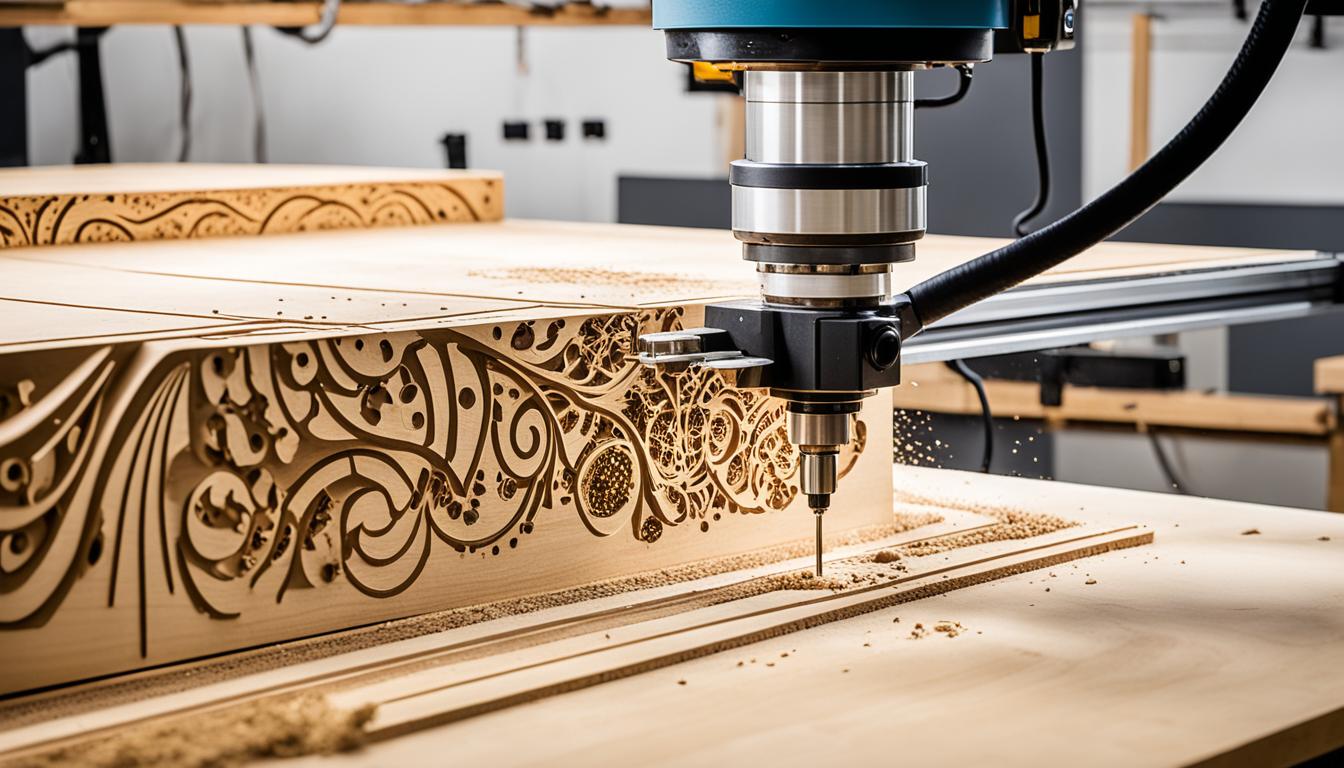
Acquiring a CNC router machine demands careful consideration of several critical technical specifications to ensure optimal performance and return on investment. Understanding the interplay between machine components and operational requirements is paramount for any serious fabrication shop or prototyping facility.
Table Bed Size Requirements
Determining the appropriate table bed size for a CNC router involves assessing both current project dimensions and anticipated future growth. Standard industrial CNC routers typically offer bed sizes ranging from 4×8 feet (1220×2440 mm) to 5×10 feet (1525×3050 mm), accommodating full sheets of common sheet goods like plywood or MDF.
Smaller desktop or hobbyist machines might feature work envelopes as compact as 12×12 inches (300×300 mm) up to 2×3 feet (600×900 mm). These are suitable for intricate parts, small-batch production, or educational purposes where material size is not a primary constraint.
Consideration must extend beyond the raw material size to include necessary fixturing and tool clearance. A machine with a slightly larger bed than your largest typical workpiece provides flexibility for workholding devices and ensures the entire part can be machined without repositioning. The Z-axis clearance, or ‘gantry height,’ is equally important, dictating the maximum material thickness and tool length that can be accommodated.
Spindle Power and Thermal Management
| Feature | Vacuum Clamping | Mechanical Clamping |
|---|---|---|
| Setup Time | Fast for flat sheets | Variable, can be slower |
| Workpiece Access | Excellent (full surface) | Can be obstructed by clamps |
| Material Suitability | Flat, non-porous sheets | Irregular shapes, small parts, porous materials |
| Holding Force | Area-dependent, high for large sheets | Very high, localized |
| Cost | Higher initial (pump, table) | Lower initial (clamps, T-slots) |
The spindle is the heart of any CNC router, directly influencing cutting capabilities, material compatibility, and overall machining efficiency. Spindle wattage, measured in kilowatts (kW) or horsepower (HP), dictates the torque available for material removal. Entry-level machines often feature spindles from 1.5 kW to 3 kW, suitable for softer woods and plastics.
Industrial applications frequently demand spindles ranging from 5 kW to 12 kW or higher, enabling aggressive cutting in hardwoods, composites, and even light aluminum. Higher wattage spindles maintain consistent RPMs under load, preventing tool chatter and improving surface finish.
Spindle cooling is a critical aspect of thermal management, directly impacting spindle longevity and performance. Air-cooled spindles, common in smaller and mid-range machines, rely on an integrated fan to dissipate heat. They are simpler to install and maintain but can be noisier and less efficient at higher power levels.
Water-cooled spindles, prevalent in high-power industrial routers, circulate coolant through the spindle housing, offering superior heat dissipation and quieter operation. These systems require a separate chiller unit, adding complexity but providing precise temperature control essential for continuous heavy-duty operation.
Workholding: Vacuum vs. Mechanical Clamping
Effective workholding is fundamental to achieving precision and safety in CNC routing operations. Two primary methods dominate: vacuum clamping and mechanical clamping. Each offers distinct advantages depending on the application and material.
Vacuum clamping utilizes atmospheric pressure to secure workpieces to a porous or zoned table. This method is exceptionally efficient for holding flat sheet materials, offering quick setup times and unobstructed access to the workpiece surface for full-sheet nesting.
The holding force of a vacuum system is directly proportional to the surface area of the workpiece and the vacuum pressure achieved. Modern vacuum pumps can generate pressures up to 25-28 inches of mercury (inHg), providing substantial clamping force for materials like MDF, plywood, and plastics.
Mechanical clamping, conversely, employs T-slots, clamps, vises, or custom fixtures to physically secure the workpiece. This method is highly versatile for irregular shapes, smaller parts, or materials that cannot form an effective vacuum seal. While offering robust holding, mechanical clamping can be more time-consuming to set up and may obstruct tool paths, requiring careful programming.
CAM Software Integration
Computer-Aided Manufacturing (CAM) software translates CAD designs into machine-readable G-code, dictating the router’s movements. Compatibility between the chosen CAM software and the CNC router’s controller is non-negotiable. Most modern CNC routers support industry-standard G-code, but specific post-processors are often required to optimize output for a particular machine’s kinematics and controller.
Popular CAM solutions for CNC routers include Fusion 360, VCarve Pro, Aspire, and Mastercam. These packages offer varying levels of complexity and features, from basic 2D profiling to advanced 3D carving and multi-axis machining. Evaluating the software’s user interface, learning curve, and available tutorials is crucial for efficient operation.
Consider the software’s ability to handle different file formats (e.g., DXF, SVG, STL) and its toolpath generation capabilities, such as nesting, engraving, pocketing, and 3D surfacing. A robust CAM package can significantly enhance productivity and expand the range of projects a CNC router can undertake.
Effective Dust Collection Systems
A well-designed dust collection system is essential for maintaining a clean workshop, protecting machine components, and ensuring operator health. CNC routers generate substantial amounts of dust and chips, particularly when machining wood, MDF, or composites.
The effectiveness of a dust collection system is primarily measured by its airflow capacity, expressed in cubic feet per minute (CFM). For typical industrial CNC routers, a system capable of 1,000 to 2,000 CFM is often recommended, with larger machines or those cutting dense materials requiring even higher capacities.
Key components of a robust dust collection setup include a high-efficiency cyclone separator, which removes larger particles before they reach the filter, and a HEPA-rated filter for capturing fine airborne dust. Ducting size is also critical; a minimum 4-inch diameter hose is generally recommended for the dust shoe, transitioning to larger main ducts to maintain airflow velocity.
Regular maintenance, including filter cleaning or replacement and emptying collection bins, is vital for sustained performance. Investing in an automated dust gate system can further optimize collection by directing airflow only to the active cutting head, maximizing efficiency.