
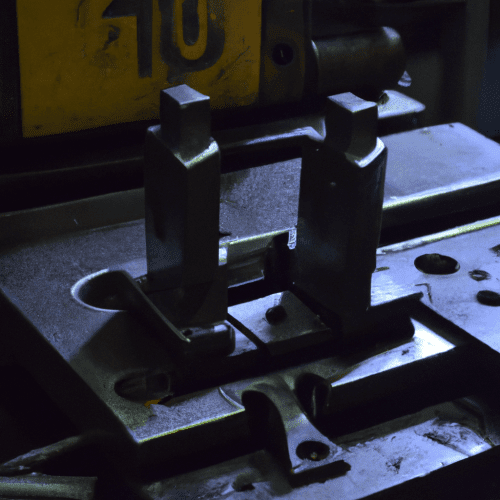
Metal stamping, also known as metal pressing, is a cold-forming manufacturing process that precisely shapes and cuts parts from flat sheets of metal. This technique utilizes specialized dies installed in powerful presses to apply force, deforming the workpiece into a desired configuration. It is a highly versatile method, capable of producing a vast array of components for diverse industrial applications.
The process is particularly well-suited for both short and long production runs, though it excels in generating large quantities of identical metal parts with high efficiency. Modern advancements in machinery, tooling, and automation have significantly enhanced its precision, speed, and overall cost-effectiveness.
Fundamentals of Metal Stamping and Die Press Forming
Die press forming involves deforming sheet material by subjecting it to tension, compression, or a combination of both. This fundamental operation relies heavily on the metal’s mechanical properties, requiring a balance between formability and strength to prevent defects like splits or wrinkles. Most forming operations incorporate a male punch and a female cavity, which together define the part’s final shape.
Presses, the driving force behind stamping, are categorized by their power source. Mechanical presses use a motor-driven flywheel to store and transfer energy to a crankshaft, delivering fast, consistent strokes. Hydraulic presses, conversely, employ pressurized fluid to generate force, offering adjustable pressure and speed, which is ideal for complex shaping and deep drawing. Servo presses, a more advanced type, provide unmatched control and precision by adjusting speed and force throughout the stroke.
Tonnage, the force a stamping machine exerts, is a critical parameter. It must be carefully calculated to prevent over-tonnage and ensure the press is adequately sized for the job. This calculation typically considers the blank’s edge length, the material’s thickness, and its shear strength.
Punching, Blanking, and Achieving Precision Tolerances
| Process / Feature | Common Tolerance Range |
|---|---|
| Blanking or Shearing | ±0.05 mm to ±0.1 mm |
| Piercing / Hole Diameter | ±0.05 mm to ±0.2 mm (thickness dependent) |
| Bending (angle accuracy) | ±1° to ±2° |
| Edge-to-hole / Hole-to-hole spacing | ±0.1 mm to ±0.2 mm |
| Coining (high-precision detail) | Up to ±0.01 mm |
Punching and blanking are two distinct yet related shearing operations in metal stamping. Punching involves cutting out a desired shape from the sheet metal, where the removed material (the slug) is considered scrap, and the remaining sheet with the hole is the desired product. This process is commonly used for creating holes or openings.
Conversely, blanking is the process where the cut-out piece itself is the desired product, while the surrounding material is discarded as scrap. Both operations utilize a punch and die set, but the key difference lies in which part of the material is retained. Blanking dies often have a larger opening to accommodate the finished product.
Achieving tight tolerances is paramount in many metal stamping applications, particularly for industries like aerospace and medical devices where even minute deviations can impact performance or safety. Tolerances define the allowable variations in dimensions during the stamping process.
Standard stamping tolerances typically range from ±0.010 to ±0.020 inches for general applications. However, for critical features requiring high reliability and perfect fit, tolerances can be as tight as ±0.001 inch or even ±0.05 mm. Material properties, stamping process parameters, and environmental conditions all influence the achievable precision.
High-Speed Sheet Metal Operations and Material Considerations
High-speed metal stamping is a precision fabrication method designed for rapid, cost-effective production of large volumes of accurate metal parts. Presses in high-speed operations can run at hundreds to over 1,000 strokes per minute (SPM), with some progressive die setups reaching up to 1,800 SPM. This accelerated pace is crucial for industries demanding quick turnaround and high throughput.
The choice of material significantly impacts high-speed stamping capabilities. Common materials include stainless steel for strength and corrosion resistance, aluminum for lightweight applications, and copper or brass for excellent electrical conductivity. High-strength alloys are also employed for demanding environments like aerospace and automotive safety components.
Operating at such high speeds introduces several technical challenges. Increased tool wear is a primary concern due to frequent use, necessitating specialized tooling technologies and maintenance. Effective stock feeding, typically using coiled material, and continuous scrap removal are essential to maintain uninterrupted operation. Furthermore, the speed, pressure, and friction generate excessive heat, requiring heat-resistant tooling and careful consideration of how heat affects material properties.
Mass Production Stamping with Progressive Die Setups
Mass production stamping is a cornerstone of modern manufacturing, enabling the efficient creation of millions of identical metal components. This process is particularly vital for industries such as automotive, electronics, aerospace, and consumer goods, where high volumes and consistent quality are non-negotiable.
Progressive die stamping is a highly efficient method for mass production, utilizing a continuous metal strip that feeds through a series of stations within a single die set. Each station performs a distinct operation—such as piercing, blanking, bending, forming, or coining—sequentially building the part’s geometry. The strip advances one precise ‘pitch length’ per press stroke, remaining attached to a carrier strip until the final station separates the completed component.
This setup allows multiple operations to occur simultaneously with each press stroke, meaning a finished part exits the die with every cycle once the strip is fully loaded. Pilot pins are often used to correct any misalignment, ensuring dimensional accuracy across all stations. The inherent automation of progressive dies drastically reduces labor costs, increases efficiency, and ensures repeatable quality, making it ideal for high-volume production of complex parts.
Modern Engineering Practices and Tooling Longevity
Contemporary metal stamping leverages advanced engineering practices to optimize production and enhance part quality. Automation plays a critical role, controlling coil feeding, press timing, part transfer, die protection, lubrication, and in-process inspection. Automated systems reduce manual handling, minimize scrap, decrease downtime, and ensure consistent output.
Servo press technology offers significant advantages in modern stamping, providing unparalleled control over press speed and force throughout the stroke. This precision allows for better metal flow, improved shape accuracy, and higher repeatability, especially for complex geometries. Such control also contributes to improved material utilization, reducing waste.
Tooling material selection is crucial for die longevity and overall profitability. Stamping dies endure repeated cycles of impact, friction, and compressive stress. High-performance tool steels like D2, A2, and CPM 3V are commonly specified for their balance of wear resistance and toughness. For extremely high-volume runs, powder metallurgy steels offer superior carbide distribution, leading to longer-lasting cutting edges.
Proper die design, including sufficient strength, optimal clearance between punch and die, and effective stress distribution, directly impacts lifespan. Regular inspection, timely maintenance, and appropriate heat treatment processes for die components are also essential to prevent premature failure and maximize the operational life of these critical tools.