
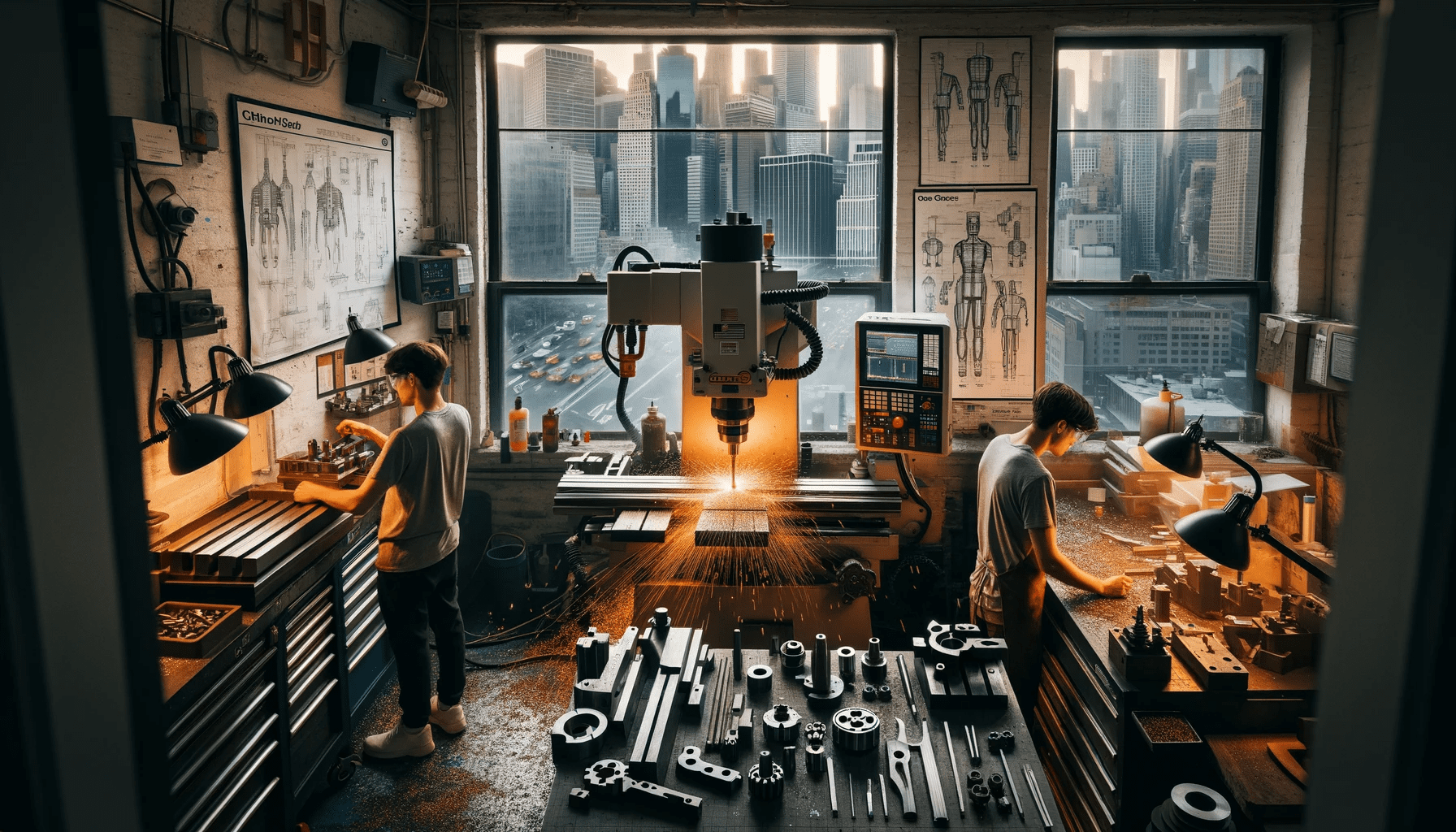
The manufacturing sector in New York demands exceptional precision and reliability, particularly within specialized industries. Computer Numerical Control (CNC) machining services across the state provide the advanced capabilities necessary to meet these stringent requirements, from initial prototyping to full-scale production runs. These shops leverage sophisticated multi-axis machines and expert engineering to deliver components with exacting specifications.
New York’s precision machine shops offer a comprehensive range of services, including CNC milling, turning, and electrical discharge machining (EDM). Many facilities are equipped with state-of-the-art 5-axis machines, enabling the production of complex parts from diverse materials, including exotic alloys like Waspaloy and Hastelloy. These operations are critical for industries where component function and safety are paramount.
Precision CNC Machining in New York
Precision CNC machining involves computer-controlled processes that shape workpieces to exact specifications, achieving high accuracy and repeatability. This method is crucial for manufacturing parts that must fit perfectly and perform reliably under demanding conditions. New York-based machine shops utilize advanced CAD/CAM technology to translate digital designs directly into precise tool paths, minimizing human error and ensuring consistent output.
Standard CNC machining typically holds tolerances of ±0.005″ to ±0.010″ (±0.13 to ±0.25 mm) on linear dimensions. However, precision applications often require much tighter tolerances, sometimes reaching ±0.0001″ or even ±0.00004″, especially for critical features. Achieving such tight tolerances demands meticulous control over tooling wear, machine thermal stability, fixturing, and rigorous inspection processes.
Geometric Dimensioning and Tolerancing (GD&T) is an essential symbolic system used in precision engineering to define allowable variations in form, orientation, location, and runout. This standardized language ensures that design intent is clearly communicated, preventing misinterpretations and guaranteeing that manufactured parts meet functional requirements. GD&T is critical for assemblies where multiple components must align perfectly.
Supporting Defense and Aerospace Manufacturing
| Parameter | Standard CNC Machining | High-Tolerance Precision Machining | Aerospace Flight-Critical Features |
|---|---|---|---|
| Linear Tolerance | ±0.005″ to ±0.010″ (±0.13 to ±0.25 mm) | ±0.001″ (±0.025 mm) or tighter | ±0.0005″ (±0.0127 mm) or better |
| Surface Finish (Ra) | 3.2 μm (125 μin) | 0.8 μm (32 μin) to 0.4 μm (16 μin) | 8 µin Ra (0.2 μm) standard, down to 0.25 µin Ra (0.006 μm) for critical rotating components |
| Typical Processes | Basic milling, turning | Multi-axis milling, turning, precision grinding | 5-axis machining, wire EDM, grinding, lapping, honing |
| Quality Certifications | ISO 9001:2015 | ISO 9001:2015, ITAR Registered | AS9100D, ISO 9001:2015, ITAR Registered, NADCAP (subcontracted) |
The defense and aerospace sectors demand the highest levels of precision and quality due to the critical nature of their applications. New York machine shops serving these industries often hold specialized certifications like AS9100D and ISO 9001:2015, demonstrating adherence to stringent quality management standards. Many are also ITAR registered, authorizing them to manufacture defense articles for controlled programs.
Aerospace components, ranging from structural elements to intricate engine parts, require tolerances as tight as ±0.001″ or even ±0.0005″ for flight-critical features. Surface finish requirements are equally stringent, with a standard of 8 µin Ra for most aerospace parts, and as low as 0.25 µin Ra for critical rotating components. These demanding specifications necessitate advanced multi-axis CNC machining, expertise in materials like titanium and Inconel, and comprehensive inspection protocols.
Many New York suppliers offer comprehensive aerospace CNC machining capabilities, including 5-axis machining, wire EDM, and mill-turn services. These shops are equipped to handle complex geometries and specialized materials, providing full documentation, material traceability, and first article inspection reports. This ensures that every component performs reliably under extreme conditions.
Rapid Prototyping and Iterative Development
Rapid prototyping services in New York are vital for product development, allowing engineers to quickly transition from conceptual designs to functional prototypes. CNC machining is a highly effective method for rapid prototyping, enabling the production of high-quality parts in small volumes for testing and validation. This process supports innovation by providing essential feedback for refining designs before full-scale production.
Local shops offer rapid manufacturing prototyping for various capabilities, including CNC milling, turning, and wire EDM, often maintaining high precision up to ±0.0001″ with quick turnaround times. These services are particularly beneficial for hardware startups in New York, providing functional, production-representative prototypes from materials like aluminum, steel, and engineering plastics within 2 to 5 business days.
The ability to quickly produce and iterate prototypes minimizes downtime and optimizes workflow, ensuring that designs meet stringent quality standards. Many prototyping services can seamlessly transition approved designs to in-house production, offering a one-stop solution for product development. This integrated approach ensures consistency from initial concept to final manufacturing.
Advanced Custom Metal Turning Operations
Custom metal turning services in New York utilize advanced CNC lathes to produce cylindrical components with unparalleled precision. This process involves rotating a workpiece while a cutting tool removes material, creating parts such as shafts, pulleys, and rods. Modern CNC lathes often feature multi-axis capabilities and live tooling, allowing for the creation of complex geometries and intricate features in a single setup.
Precision CNC turning can handle a wide array of materials, including various steels, stainless steel, aluminum, brass, beryllium copper, and engineering plastics. Shops offer services for both prototypes and small-run production volumes, catering to diverse industry needs, including commercial and military applications. The emphasis is on achieving stringent dimensional and surface finish requirements.
Many facilities provide large capacity precision CNC turning, capable of handling diameters up to 60 inches and lengths up to 80 inches. These advanced capabilities, combined with secondary services like grinding, honing, and lapping, ensure that turned components meet the highest standards for accuracy and surface quality.
High-Tolerance Milling Centers
High-tolerance milling centers in New York are equipped with sophisticated CNC milling machines, including 3, 4, and 5-axis systems, to perform complex operations with exceptional precision and speed. These machines use rotary cutters to remove material, creating intricate features, complex 3D contours, and prismatic parts. The higher the number of axes, the greater the operational flexibility and the ability to produce highly complex components.
Milling centers routinely achieve tight tolerances, often ±0.001″ or even ±0.0005″ on precision features, supported by rigorous in-process and final inspection. Materials commonly machined include aluminum, steel, stainless steel, and various plastics. Some specialized shops excel in machining challenging materials like titanium and Inconel, which are frequently used in aerospace and defense applications.
Modern milling operations often incorporate automation packages for ‘lights-out’ manufacturing, enhancing efficiency and consistency for both short-run, highly complex parts and high-production volumes. The integration of advanced metrology equipment, such as Coordinate Measuring Machines (CMMs), ensures absolute accuracy and compliance with design specifications.