
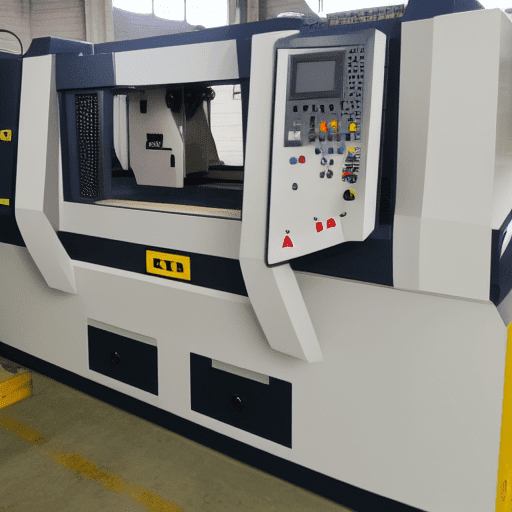
Modern manufacturing increasingly relies on Computer Numerical Control (CNC) machines to meet the evolving demands of various industries. These sophisticated systems offer unparalleled precision, efficiency, and versatility, making them indispensable for producing high-quality components. The shift towards CNC technology is driven by several critical factors, including the need for tighter tolerances, scalable production, reduced labor costs, and the ability to fabricate complex 3D geometries.
CNC machines automate industrial manufacturing processes, translating digital instructions into precise physical material removal. This computer-controlled approach minimizes human error and ensures consistent output across production runs, a significant advantage over traditional manual machining methods.
Precision Demands Drive CNC Adoption
Industries such as aerospace, medical, and automotive require components with extremely tight tolerances to ensure optimal performance and safety. CNC machines excel in delivering this level of precision, consistently producing parts within specified measurements that are often impossible to achieve manually.
Standard CNC machining tolerances typically range from ±0.05 mm (±0.002 inches) for general components, with precision-grade applications achieving ±0.01 mm (±0.0004 inches). For ultra-high precision, such as aerospace and medical-grade parts, tolerances can be as tight as ±0.002-0.005 mm. Achieving these exacting standards requires careful process control, proper tooling, and often a temperature-controlled environment.
Surface finish is another critical aspect of precision, with a standard ‘as-machined’ roughness typically around Ra 3.2 µm (125 µin). However, a finishing pass can reduce this significantly to Ra 1.6, 0.8, or even 0.4 µm for smoother functional surfaces. This capability is vital for components where surface texture directly impacts wear, sealing, or fatigue life.
Accelerated Production Scaling with CNC
| Parameter | Manual Machining | Standard CNC Machining | Precision CNC Machining |
|---|---|---|---|
| Typical Tolerance | ±0.1 mm to ±0.5 mm | ±0.05 mm (±0.002″) | ±0.01 mm (±0.0004″) |
| Surface Finish (Ra) | Rougher, often requires secondary finishing | 3.2 µm (125 µin) | 0.4 µm to 1.6 µm (16-63 µin) |
| Complexity | Limited to simpler geometries | Moderate 2.5D and some 3D shapes | Complex 3D, multi-axis, undercuts |
| Repeatability | Highly operator-dependent | High, consistent across batches | Exceptional, critical for regulated industries |
| Production Speed | Slower, labor-intensive | Faster, automated cycles | Very fast, high-volume, lights-out potential |
Manufacturers face constant pressure to increase output and meet tight deadlines, making production speed scaling a key driver for CNC adoption. CNC machines operate at optimized spindle speeds and feed rates, drastically shortening production time per part compared to manual methods.
Automated CNC systems can run continuously, 24/7, without requiring breaks, shifts, or sleep, significantly increasing machine uptime and productivity. This ‘lights-out manufacturing’ capability allows shops to produce high volumes of parts around the clock, maximizing throughput and meeting demanding production targets more efficiently.
High-speed CNC machines, equipped with advanced spindle motors reaching 15,000 to 60,000 RPM, can machine materials like aluminum, titanium, and composites up to 70% faster. This rapid material removal, combined with automated tool changers and optimized cutting paths, ensures consistent quality across large production runs.
Optimizing Labor Costs Through Automation
Labor costs represent a significant portion of manufacturing expenses. CNC automation helps reduce these costs by minimizing the need for constant human intervention during the machining process.
One skilled operator can supervise multiple CNC machines simultaneously, a stark contrast to manual machining which requires a dedicated worker for each machine. This improved labor efficiency allows manufacturers to reassign skilled personnel to higher-value tasks like programming, process optimization, and quality control.
The ability of CNC machines to operate unattended, particularly during off-hours, further reduces labor dependency and lowers long-term operational costs. While initial investment in automated CNC machinery can be substantial, the long-term savings on operating costs, reduced waste, and increased output make it a cost-effective solution.
Unlocking Complex Geometries with Multi-Axis CNC
Modern product designs frequently feature intricate geometries, organic shapes, and undercut features that are challenging or impossible to produce with traditional 3-axis machining. CNC machines, especially multi-axis systems, are specifically designed to handle these complex 3D part needs.
Five-axis CNC machines, for instance, add two rotational axes to the standard X, Y, and Z, allowing the cutting tool to approach the workpiece from virtually any angle. This capability enables the creation of complex contours, curved surfaces, and holes at odd angles in a single setup, eliminating the need for multiple repositioning and reducing potential errors.
Industries like aerospace and medical rely heavily on 5-axis CNC machining for components such as turbine blades, orthopedic implants, and surgical instruments, which demand precise execution on complex forms. The continuous tool movement also results in better surface finishes and extended tool life.
Seamless Workflow via CAD/CAM Integration
The integration of Computer-Aided Design (CAD) and Computer-Aided Manufacturing (CAM) software is fundamental to modern CNC machining, streamlining the entire product development process. CAD software allows engineers to create detailed 3D models, capturing all design specifications, dimensions, and tolerances.
CAM software then directly translates these CAD models into G-code, the numerical control programming language that directs the CNC machine’s movements, tool paths, cutting speeds, and feed rates. This seamless integration eliminates manual programming, reduces errors, and significantly accelerates project turnaround times.
Integrated CAD/CAM solutions enhance accuracy and repeatability by maintaining a connected data flow from design to manufacturing. Design changes automatically propagate through the system, updating toolpaths without requiring recreation from scratch, which reduces rework and improves consistency from prototype to production. Furthermore, simulation capabilities within CAM software help validate toolpaths and prevent costly machine collisions before actual machining begins.