
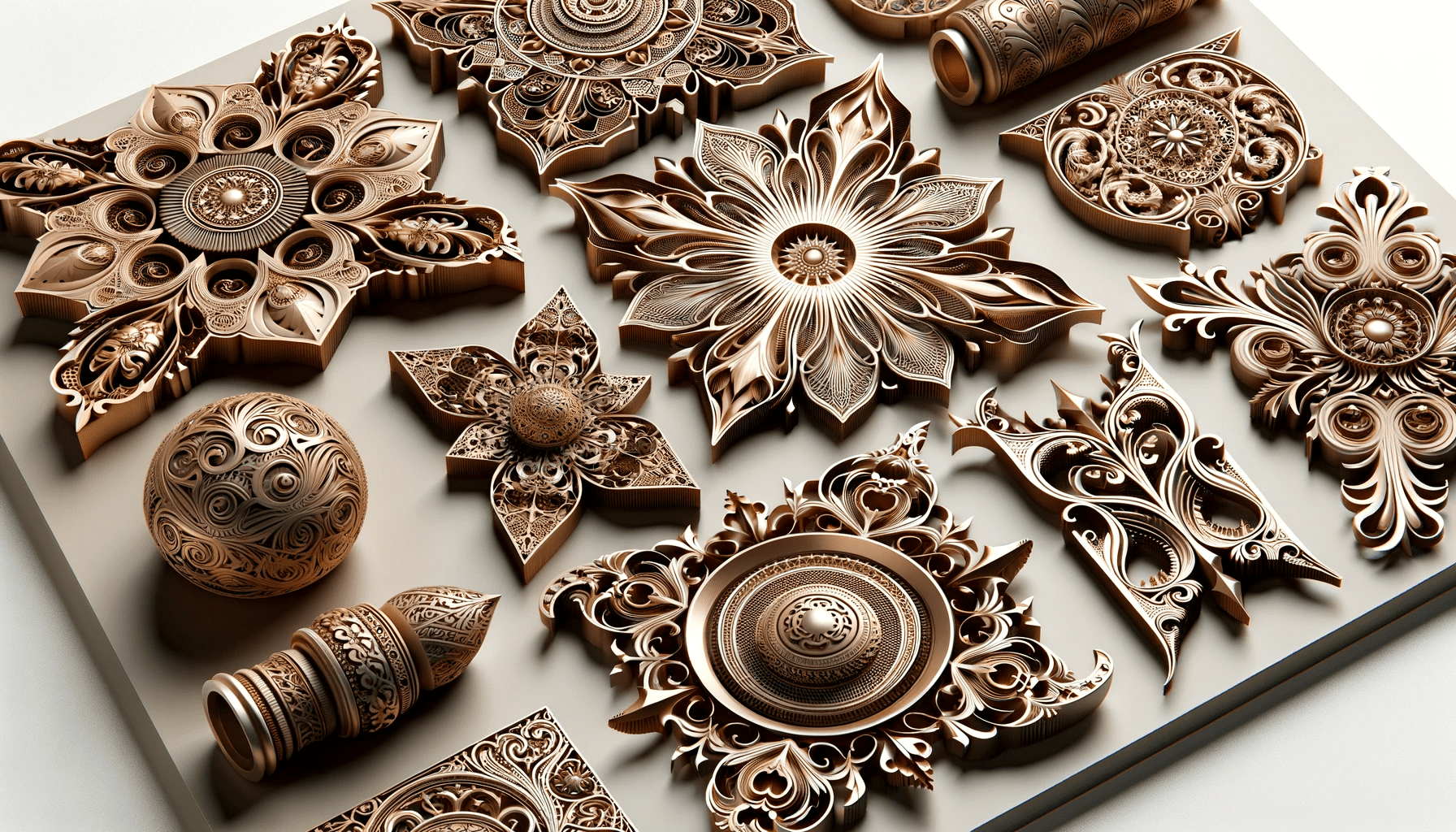
Computer Numerical Control (CNC) technology has revolutionized woodworking, enabling unparalleled precision and consistency in crafting intricate designs. This advanced automation transforms raw materials into detailed artistic creations, making it an indispensable tool for producing custom Christmas ornaments. Modern CNC routers and laser cutters offer the capability to engrave and cut various materials with exceptional accuracy, minimizing human error and maximizing efficiency.
Creating custom holiday decorations with CNC machines allows for both intricate detail and scalable production. Whether producing small batches for personalized gifts or large runs for commercial purposes, the digital workflow ensures each ornament meets exacting standards. This guide explores the technical aspects of leveraging CNC for festive ornament production, from material selection to advanced machining strategies.
Plywood Laser-CNC Cutting Techniques
Selecting the appropriate plywood is paramount for successful laser cutting and engraving. Baltic Birch plywood, known for its consistent, void-free layers, is a preferred material for detailed CNC work, including signs and game boards. Maple plywood also offers a smooth, even surface ideal for engraving.
Conversely, construction-grade plywood often contains voids and inconsistent glue lines that can lead to chipping and delamination during machining, particularly with fine details. For projects prioritizing flatness, MDF or hardwood plywood with an MDF core are excellent choices, providing stability against warping.
Laser cutting parameters are critical for achieving clean, consistent through-cuts with minimal charring. For 3mm plywood, a common principle is to maintain an energy index between 2.5 and 3.0 J/mm with air assist. This vaporizes wood and glue layers effectively.
Diode lasers, ranging from 10W to 40W, are widely used for cutting 3mm plywood. A 10W diode laser might require 3-6 passes at 90-100% power and speeds around 300-600 mm/min, while a 20W diode can achieve cuts in 1-2 passes at 80-100% power and approximately 1000 mm/min. Air assist is non-negotiable, as it clears smoke and debris, reduces charring, and prevents fires.
Achieving Double-Sided Ornament Milling Accuracy
| Laser Wattage | Power (%) | Speed (mm/min) | Passes | Air Assist |
|---|---|---|---|---|
| 10W Diode | 90-100% | 300-600 | 2-3 | Recommended |
| 20W Diode | 80-100% | ~1000 | 1-2 | Recommended |
| 38W CO2 | 90% | ~600 | 1 | Recommended |
Double-sided CNC machining is essential for creating ornaments with features on both faces, requiring precise alignment between operations. The primary challenge lies in maintaining accurate registration after flipping the workpiece. Even minor misalignment can lead to dimensional errors or mismatched contours.
Registration features are critical for accurate repositioning. Dowel pin holes are a popular and highly repeatable method. These precision holes are machined during the first setup, then used to align the part precisely for the second operation.
Custom fixtures, vacuum tables, or indexed workholding systems also facilitate accurate double-sided milling. Modern CAM software often includes tools for mirrored toolpaths and managing flip operations, simplifying the process. However, careful setup, accurate zeroing, and understanding machine coordinates remain crucial.
For hobbyist CNC work, a common strategy involves creating location holes in the top side of the workpiece and mirrored holes in the wasteboard. Dowels then serve as location pins. The X and Y zero locations remain constant after flipping, with only the Z-axis requiring adjustment.
Precision Ribbon Hole Pocketing Strategies
Creating clean ribbon holes in ornaments demands specific tooling and machining parameters. Small-diameter end mills are ideal for micro CNC machining, enabling tight inside corners, fine details, and access to narrow slots. These delicate tools require careful feeds and speeds.
Two-flute up-cut end mills are effective for general material removal in wood, pulling chips away from the cut path and preventing tool breakage. For a superior finish, particularly on the final pass, a down-cut or compression end mill is often preferred.
For 1/8′ (3.175mm) end mills in plywood, typical feed rates can range from 150 to 180 inches per minute (IPM) at spindle speeds between 18,000 and 20,000 RPM. A depth of cut (DOC) of 1/8′ to 1/4′ per pass is common, with multiple passes often employed to prevent bit breakage, especially with longer flute lengths.
Engraving router bits, often V-groove or fine detail tapered ball nose bits, are essential for intricate designs and sharp grooves. These carbide bits are designed for high precision and can create detailed text and ornamental patterns in hardwood or plywood.
Crafting Custom Tree Decorations
Custom tree decorations benefit immensely from CNC’s ability to produce unique, personalized items. Laser engraving allows for crisp internal lines and personalized text, such as names or dates, which significantly increases an ornament’s value.
Design software like LightBurn or Fusion 360 is crucial for preparing ornament designs, allowing for resizing, ungrouping elements, and arranging multiple designs efficiently to minimize material waste. The workflow typically involves engraving first, then inside cuts, and finally outside profile cuts.
For layered, three-dimensional effects, multiple plywood layers can be cut and then glued together, adding depth to the design. This technique expands creative possibilities beyond simple flat ornaments.
Standard CNC machining tolerances are typically ±0.005 inches (±0.127 mm) for most linear dimensions, which is sufficient for general ornament features. For mating parts or critical fits, tighter tolerances of ±0.002 inches (±0.050 mm) may be specified, though this increases machining time and cost.
Optimizing Batch Carving Setups
Batch carving setups are fundamental for efficient, high-volume ornament production. This involves designing fixtures that can securely hold multiple workpieces in a single clamping operation. Such fixtures reduce setup time and ensure consistent positioning across all parts.
Fixture design often incorporates positioning pins, such as cylindrical and rhombic pins, to accurately locate each workpiece. The distances between these elements must be precise to ensure the machine tool moves accurately according to the program.
Nesting multiple ornament designs on a single sheet of plywood optimizes material usage and allows for continuous engraving and cutting without shifting the sheet. This approach is particularly effective for scaling production from small family runs to large organizational orders.
Implementing robust dust extraction systems is vital in batch carving environments. CNC machining generates significant wood dust, which can affect worker safety, machine performance, and the quality of the finished product. Proper dust management maintains a clean workspace and prolongs machine life.