
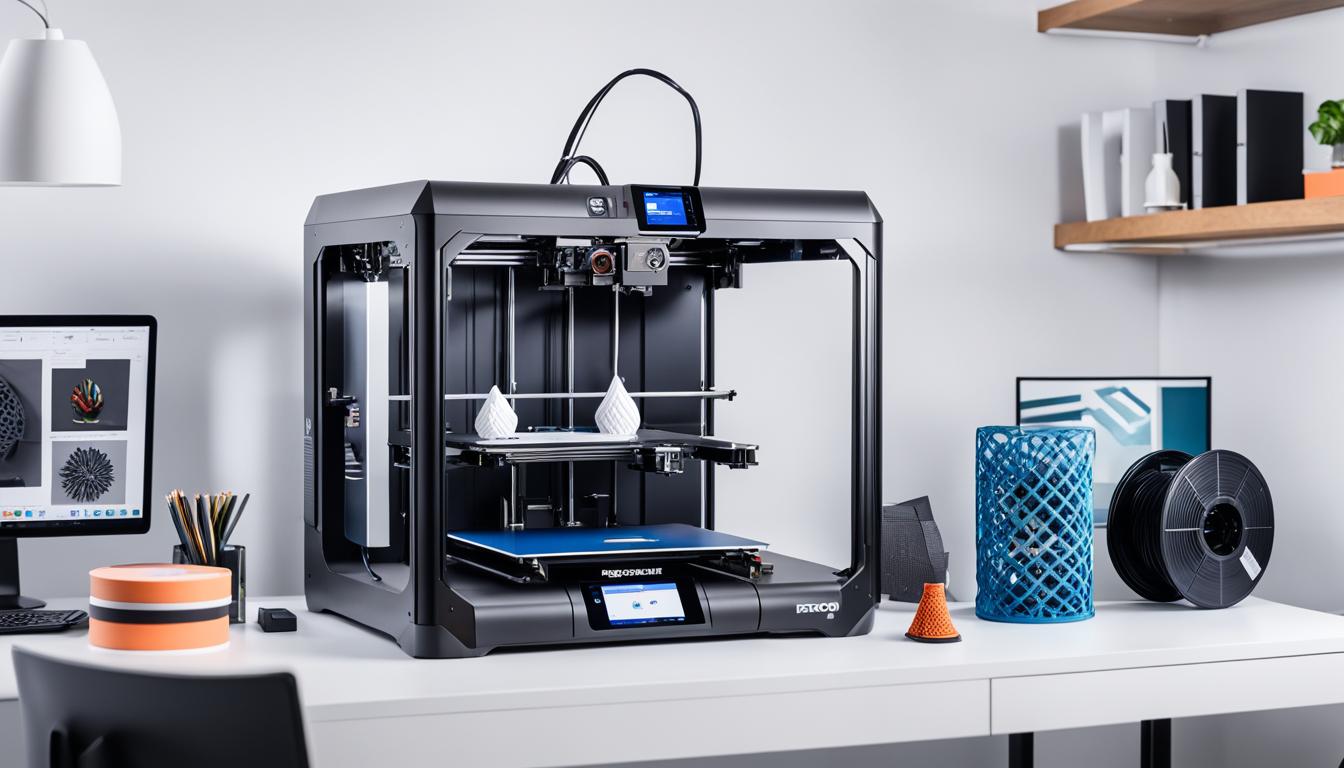
Ultimaker 3D printers are engineered for professional applications, providing robust solutions for additive manufacturing across various industries. Their integrated ecosystem, combining hardware, software, and materials, facilitates high-precision part production.
These systems are designed for reliability and repeatability, crucial for industrial environments where consistent part quality is paramount. The latest models, such as the Ultimaker S7 and Factor 4, offer advanced features that enhance precision and operational efficiency.
Dual Extrusion FDM Technology
Ultimaker’s dual extrusion Fused Deposition Modeling (FDM) technology significantly expands printing capabilities, allowing for the use of multiple materials within a single print job. This enables the creation of complex functional parts, multi-color models, and intricate geometries with soluble support structures.
A key advantage of dual extrusion is the ability to print with soluble support materials like PVA or RapidRinse. These materials dissolve in water, simplifying post-processing and enabling the production of parts with complex overhangs, internal cavities, and fine details that would be challenging with traditional breakaway supports.
The dual extrusion system on Ultimaker S-series and Factor 4 printers features an auto-nozzle lifting mechanism, which prevents the inactive nozzle from dragging through the print and causing material contamination or surface imperfections. This mechanism ensures clean transitions between materials and maintains print quality.
Maintaining optimal performance of the dual extrusion system requires precise calibration. The ‘lift switch’ calibration, for instance, ensures correct nozzle alignment and proper functioning of the print core switching mechanism, which is vital for active leveling and successful dual-material prints.
Cura Slicer Software Integration
| Material Type | Nozzle Temperature (°C) | Build Plate Temperature (°C) | Typical Layer Height (mm) | Achievable Tolerance (mm) |
|---|---|---|---|---|
| Nylon | 240-260 | 60-70 | 0.15-0.25 | ±0.2 or ±0.2% |
| Polycarbonate (PC) | 260-280 | 100-110 | 0.1-0.2 | ±0.2 or ±0.2% |
| ABS | 220-240 | 80-100 | 0.15-0.25 | ±0.2 or ±0.2% |
| TPU 95A | 220-230 | 60-70 | 0.15-0.25 | ±0.3 |
| PET CF | 260-280 | 70-80 | 0.1-0.2 | ±0.2 or ±0.2% |
Ultimaker Cura serves as the central slicing software, offering a comprehensive platform for preparing 3D models for printing. Its intuitive interface and extensive features allow users to optimize print settings for precision, speed, and material properties.
Advanced settings within Cura, such as adaptive layers, infill patterns, and flow calibration, are critical for achieving high-quality results. Adaptive layers dynamically adjust layer height based on model geometry, improving surface finish on curved areas while maintaining speed on simpler sections. Flow calibration ensures consistent material extrusion.
Cura seamlessly integrates with Ultimaker’s material profiles, which are extensively tested and optimized for specific filaments. This integration automatically configures complex printing parameters, minimizing user intervention and ensuring reliable print outcomes.
The Ultimaker Digital Factory further enhances Cura’s capabilities by providing a cloud-based slicing solution. This allows users to prepare and optimize models from any location, send secure print jobs remotely, and monitor print progress, streamlining the entire workflow.
Industrial Prototype Printing Capabilities
Ultimaker printers are widely utilized for industrial prototyping, enabling rapid iteration and functional testing of designs. The ability to produce dimensionally accurate parts quickly accelerates product development cycles and reduces time-to-market.
Achieving high accuracy and repeatability is paramount in industrial applications. Ultimaker’s Factor 4, for example, is engineered to produce parts within 0.2% of nominal part length, making it suitable for many production applications requiring strict tolerances.
Industrial FDM printers typically achieve dimensional tolerances ranging from ±0.2 mm or ±0.2% of the nominal feature length, whichever is greater. Factors like layer height, print speed, material consistency, and proper printer calibration significantly influence the final part accuracy.
Engineering Filament Printing
Ultimaker printers support a broad spectrum of engineering-grade filaments, allowing for the creation of functional prototypes, tooling, and end-use parts with specific mechanical, thermal, and chemical properties. These materials are crucial for demanding industrial applications.
Materials like Nylon offer excellent strength, impact resistance, and flexibility, along with good abrasion and chemical resistance, making them ideal for tools and functional prototypes. Polycarbonate (PC) provides high mechanical strength, UV stability, and thermal resistance up to 110 °C, suitable for molds and engineering components.
Composite materials such as PET CF (Polyethylene Terephthalate Carbon Fiber) provide enhanced strength, stiffness, and temperature resistance, with annealing capable of increasing thermal resistance to 181 °C. TPU (Thermoplastic Polyurethane) offers rubber-like flexibility, high abrasion resistance, and tear strength for flexible parts.
Enterprise 3D Print Farms
Enterprise 3D print farms leverage multiple Ultimaker machines in a centralized setup to scale production, increase throughput, and reduce lead times for manufacturing. This approach offers unmatched flexibility and efficiency for businesses.
Ultimaker Digital Factory provides powerful cloud-based tools for managing these print farms, enabling remote monitoring, print job queuing, and detailed reporting on printer performance and material usage. This centralized control streamlines operations and minimizes downtime.
The scalability of Ultimaker print farms allows organizations to start with a few printers and expand as demand grows, adding more machines to meet increasing production capacity without significant upfront investments in traditional tooling. This adaptability supports agile manufacturing strategies.
Print farms also enhance collaboration and security within an organization. Administrators can manage user access, share printers among teams with granular control, and utilize features like PIN code protection and firmware firewalls to secure the printing infrastructure.