
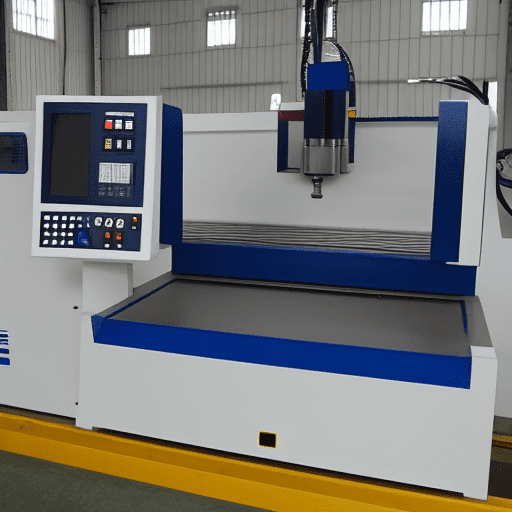
Modern manufacturing relies heavily on precision and efficiency, driving significant advancements in milling technology. Comparing a contemporary Computer Numerical Control (CNC) milling machine with a traditional manual-controlled milling machine from the past reveals fundamental differences across various operational and performance metrics.
These distinctions are critical for tooling engineers to understand, impacting everything from part quality to production economics. The evolution from direct human manipulation to sophisticated computer automation has reshaped machining capabilities, offering unparalleled control and consistency in material removal processes.
Automation Capabilities
Contemporary CNC milling machines integrate extensive automation features, fundamentally altering the manufacturing workflow. These systems often include automatic tool changers (ATCs), pallet changers, and robotic loading/unloading systems, enabling ‘lights-out’ manufacturing where machines operate autonomously for extended periods.
Furthermore, advanced CNC machines seamlessly integrate with Manufacturing Execution Systems (MES), Enterprise Resource Planning (ERP) platforms, and Internet of Things (IoT) sensors. This connectivity facilitates real-time data logging, remote diagnostics, and predictive maintenance, enhancing overall operational intelligence and traceability.
Conversely, manual milling machines require constant, direct operator intervention for every axis movement and tool change. The machinist physically manipulates handwheels to control X, Y, and Z axes, relying on visual cues and digital readouts (DROs) for positioning.
Dimensional Accuracy
Achieving precise dimensions is a hallmark of modern CNC milling, with typical accuracy levels ranging from ±0.005 inches (0.13 mm) for general work. For high-precision tasks, CNC machines can achieve tolerances as tight as ±0.001 inches (0.025 mm), and specialized techniques can push this to ±0.0001 inches (0.0025 mm) or even 1-5 microns.
This exceptional precision stems from rigid machine construction, high-quality ballscrews, backlash compensation, and advanced control algorithms that account for factors like thermal expansion. Positional accuracy on professional CNC machines can be as fine as ±0.0004 inches (0.01 mm) or better, with some achieving ±0.0002 inches (0.005 mm) on linear-guided models.
Manual milling machines, while capable of good accuracy in skilled hands, typically operate within a broader practical range of around ±0.05 mm (±0.002 inches) for general features. The achievable precision is heavily dependent on the operator’s skill, the machine’s condition, tooling, workholding, and measurement methods, introducing variability that is difficult to eliminate.
Machining Speed
CNC milling machines offer significantly higher machining speeds and throughput compared to their manual counterparts. Once programmed, these machines can execute complex toolpaths continuously with minimal human intervention, dramatically reducing cycle times.
Spindle speeds on modern CNC mills can reach 15,000 to 20,000 RPM, allowing for efficient material removal across a wide range of materials, from aluminum to hardened steels. Feed rates, measured in units per minute, are precisely controlled by the CNC program, optimizing cutting conditions for tool life and surface finish.
In contrast, manual milling operations are inherently slower due to the need for constant manual adjustments and operator decision-making. Each axis movement, depth of cut, and feed rate must be set and controlled by the machinist, limiting the overall pace of material removal.
Operator Skill Requirements
Operating a modern CNC milling machine demands a distinct set of skills centered around digital proficiency and process management. CNC operators must possess a strong understanding of G-code programming, Computer-Aided Manufacturing (CAM) software, and the ability to interpret complex technical drawings and CAD designs.
Their role shifts from direct physical manipulation to setting up machines, loading raw materials, monitoring operations, and performing quality inspections using precision measurement tools. Mathematical and analytical skills are crucial for understanding tolerances, conversions, and troubleshooting minor issues.
Manual milling machine operators, on the other hand, require extensive hands-on experience, exceptional mechanical aptitude, and precise hand-eye coordination. They must be adept at reading blueprints, using traditional measuring tools like micrometers and calipers, and making real-time adjustments based on tactile feedback and visual inspection.
Production Efficiency
Production efficiency is a primary differentiator, with CNC machining significantly outperforming manual methods for high-volume and complex part manufacturing. Once a program is validated, CNC machines can produce consistent, high-quality parts repeatedly with minimal supervision, reducing labor costs and overall production time.
Automation features like tool changers and robotic systems further enhance productivity by minimizing setup times and allowing for continuous, uninterrupted operation. This leads to higher throughput and reduced waste due to the elimination of human error.
Manual machining is generally more labor-intensive and time-consuming, making it less efficient for large-scale or repetitive manufacturing. However, it remains highly efficient for one-off simple parts, repair work, fixture modification, or prototypes where the time required for CNC programming would outweigh the benefits.
Initial Investment Cost
The initial investment for a modern CNC milling machine is substantially higher than that for a manual machine. Hobbyist or entry-level CNC machines can range from $1,500 to $5,000.
Professional 3-axis CNC milling machines for industrial applications typically cost between $20,000 and $150,000. High-end 5-axis machining centers or multi-tasking platforms can exceed $150,000, with some reaching over $500,000, depending on configuration, spindle power, and automation features.
Conversely, manual milling machines, especially used models, represent a much lower initial capital outlay. While specific current prices for new manual mills are less frequently cited, their cost-effectiveness for short production runs and lower setup expenses indicate a significantly reduced upfront investment compared to CNC systems.
Tolerances and Repeatability
Modern CNC milling machines excel in holding tight tolerances and achieving high repeatability, which is crucial for interchangeable parts and complex assemblies. Standard CNC machining tolerances are typically ±0.005 inches (±0.127 mm) for most metals. Precision machining services can achieve ±0.001 inches (±0.0254 mm) to ±0.002 inches (±0.0508 mm), with tight tolerance services reaching ±0.0001 inches (±0.0025 mm) or better.
Repeatability, defined as the machine’s ability to consistently return to a commanded position, is a key strength of CNC technology. Professional CNC machines often boast repeatability figures of ±0.0005 inches (0.0127 mm) or better, with some high-end systems achieving ±0.00007 inches (0.001778 mm) under controlled conditions.
Manual milling machines struggle to match the repeatability of CNC systems due to inherent human variability. While a highly skilled operator might achieve tight dimensions on a single feature, maintaining consistent positional accuracy and feature-to-feature relationships across multiple parts or complex geometries is challenging.
| Parameter | Modern CNC Milling Machine | Manual-Controlled Milling Machine |
|---|---|---|
| Automation Capabilities | High (ATCs, robotics, MES/ERP integration, lights-out) | Low (Direct operator control, manual adjustments) |
| Dimensional Accuracy | ±0.005″ (general), ±0.001″ (precision), up to ±0.0001″ or 1-5 microns (tight) | ±0.002″ (±0.05 mm) for general features (operator dependent) |
| Machining Speed | High (Continuous operation, 15,000-20,000+ RPM spindles, programmed feed rates) | Lower (Manual feed/speed adjustments, operator-paced) |
| Operator Skill Requirements | G-code/CAM programming, blueprint reading, system monitoring, troubleshooting | Mechanical aptitude, precise measurement, hand-eye coordination, extensive experience |
| Production Efficiency | Very High (High-volume, complex parts, reduced labor/waste) | Lower (Best for one-off, simple parts, repairs, prototypes) |
| Initial Investment Cost | $20,000 – $500,000+ (Professional industrial machines) | Significantly lower (Especially for used machines) |
| Tolerances and Repeatability | Excellent (±0.005″ standard, ±0.0005″ repeatability, even tighter) | Good for isolated features, lower repeatability across multiple parts (operator dependent) |