
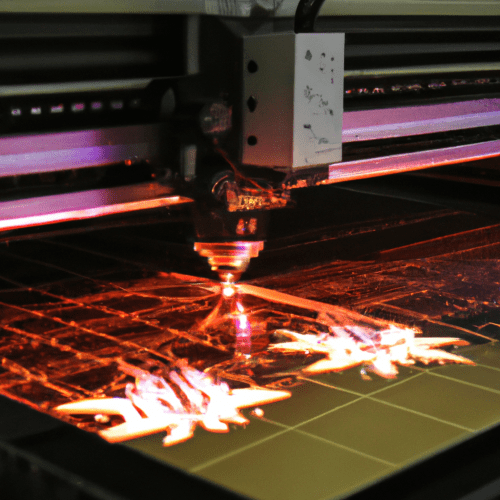
Laser cutting machines represent a cornerstone of modern manufacturing, utilizing a highly concentrated beam of light to precisely cut or engrave materials. This non-contact thermal process offers exceptional accuracy and versatility across a vast array of industries, from automotive to medical device production. The core principle involves directing a high-power laser, controlled by computer numerical control (CNC), through optics to melt, burn, or vaporize material along a defined path.
These sophisticated systems integrate a laser source, a precise motion system, and advanced control software to achieve accurate material removal. The focused energy creates a narrow cut, known as a kerf, by rapidly heating the material until it changes phase. An assist gas then plays a crucial role in expelling the molten or vaporized material, ensuring a clean and precise cut.
Focused Light Beam Cutting Fundamentals
Focused light beam cutting relies on concentrating a significant amount of laser power into an extremely small spot size on the material’s surface. This concentration of energy is termed ‘power density,’ measured in watts per square centimeter (W/cm²). A higher power density enables more efficient material removal, leading to cleaner cuts and finer details.
The laser beam’s power density is a critical parameter, directly influencing cutting speed, quality, and precision. It is calculated by dividing the laser power by the area of the focused spot. Even lower-power lasers can achieve faster, cleaner cuts if their beam spot is sufficiently small, thereby increasing power density.
Optimizing the focal point’s position relative to the material surface is essential for effective cutting. An incorrect focus can lead to an uneven kerf, reduced energy density at the cutting front, and hinder the efficient ejection of molten material, potentially causing defects like dross.
CO2 versus Fiber Laser Technologies
| Feature | CO2 Laser | Fiber Laser |
|---|---|---|
| Wavelength | ~10.6 µm | ~1.064 µm |
| Typical Materials | Wood, acrylic, paper, rubber, plastics, some metals | Metals (stainless steel, aluminum, copper, brass) |
| Energy Efficiency | 5-10% | 45-50% |
| Cutting Speed (Thin Metals) | Slower | 3-6x faster than CO2 |
| Maintenance | Regular, tube replacement | Minimal, virtually maintenance-free |
| Kerf Width | 0.25-0.5 mm | 0.1-0.5 mm (often 0.15-0.5 mm) |
Two primary laser technologies dominate the industrial cutting landscape: CO2 lasers and fiber lasers. Each offers distinct advantages and is suited for different material types and thicknesses. Understanding their fundamental differences is crucial for selecting the appropriate machine for specific applications.
CO2 lasers generate a beam from an electrically stimulated gas mixture, primarily carbon dioxide, nitrogen, and helium, typically operating at a wavelength around 10.6 µm. This wavelength is highly absorbed by non-metallic materials such as wood, acrylic, paper, rubber, and certain plastics, making CO2 lasers versatile for these applications.
Fiber lasers, conversely, utilize solid-state fibers doped with rare-earth elements to generate their beam, typically at a wavelength of 1.064 µm. They excel at cutting highly reflective metals like stainless steel, aluminum, and copper. Fiber lasers are known for their superior energy efficiency, converting 45-50% of electrical energy into laser output, compared to CO2 lasers’ 5-10%.
Assist Gas Delivery and Its Functions
Assist gas delivery is integral to the laser cutting process, significantly influencing cut quality, speed, and overall efficiency. The gas stream, delivered coaxially with the laser beam, performs several critical functions. It primarily ejects molten material from the kerf, preventing re-solidification as dross on the cut edge.
Beyond material ejection, assist gases cool the cutting zone, minimizing thermal distortion and warping of the workpiece. They also shield the cutting area from ambient air, preventing unwanted oxidation that can compromise edge quality, especially for reactive metals.
Common assist gases include oxygen, nitrogen, and compressed air, each selected based on the material type, thickness, and desired edge finish. Oxygen is often used for carbon steel, as it creates an exothermic reaction that enhances cutting speed and energy. However, this can lead to oxidized, rougher edges.
Nitrogen, an inert gas, is preferred for stainless steel, aluminum, and other non-ferrous metals. It prevents oxidation, resulting in clean, oxide-free cuts with superior edge quality, crucial for parts requiring subsequent welding or painting. Compressed air, a cost-effective alternative, contains approximately 21% oxygen and can be used for non-critical cuts on thinner materials where some oxidation is acceptable.
Precision Motion Control: the CNC Gantry
The CNC motion gantry is the mechanical framework that precisely positions the laser cutting head over the workpiece. This system is paramount for achieving the high accuracy and repeatability demanded by modern manufacturing. Gantry designs typically employ robust linear guides and precision drive mechanisms.
Advanced laser cutting machines often utilize linear motors for their gantry systems, offering high acceleration, speed, and dynamic accuracy without mechanical wear. Other common drive systems include rack and pinion or ball screw mechanisms, which provide reliable and precise motion when coupled with high-resolution encoders and servo motors.
The accuracy of the CNC gantry directly impacts the dimensional tolerances of the cut parts. Standard tolerances for laser-cut components can be as tight as ±0.05 mm, depending on the machine, material, and thickness. Maintaining optimal alignment and calibration of the gantry system is crucial for consistent part quality.
Material Thermal Melting and Interaction
Laser cutting fundamentally involves the thermal interaction between the focused laser beam and the material. The intense energy delivered by the beam rapidly heats the material, causing it to melt, vaporize, or sublimate. This localized heating creates a narrow channel, or ‘kerf,’ through the workpiece.
The kerf width, the amount of material removed during cutting, typically ranges from 0.08 mm to 1 mm, varying with laser type, power, material, and thickness. Fiber lasers generally produce narrower kerfs (0.15-0.5 mm) compared to CO2 lasers (0.25-0.5 mm), especially on thinner materials.
A significant consideration in thermal cutting is the Heat Affected Zone (HAZ), the area of the material adjacent to the cut that undergoes changes in microstructure or properties due to heat. Higher power density typically results in a smaller HAZ, minimizing thermal damage to surrounding areas and preserving material integrity.
Dross, or re-solidified molten material, can form on the underside of the cut edge if the assist gas fails to completely eject the molten material. Factors like incorrect laser power, cutting speed, assist gas pressure, and nozzle condition all contribute to dross formation. Optimizing these parameters is essential for achieving dross-free cuts.