
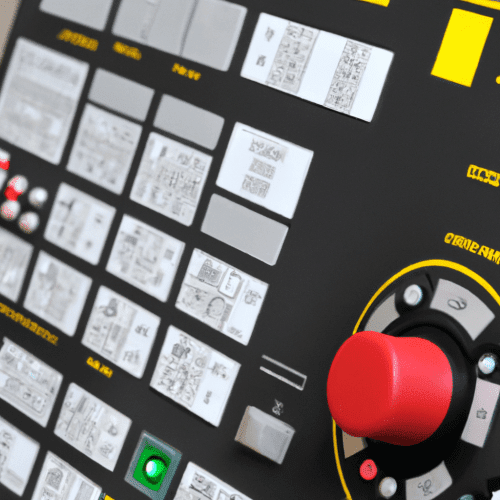
Modern manufacturing relies heavily on advanced CNC and robotics controllers to achieve precision, efficiency, and automation. These sophisticated systems dictate machine tool movements, manage complex processes, and integrate seamlessly with broader factory automation ecosystems. Understanding the capabilities of leading manufacturers is crucial for engineers designing and optimizing production lines in 2026.
Standard CNC machining tolerances typically range from ±0.05 mm to ±0.13 mm for most milling and turning operations. Achieving tighter tolerances, such as ±0.01 mm, often requires specialized equipment, careful process control, and experienced operators, increasing costs significantly.
Fanuc Automation: Precision and Reliability
Fanuc remains a dominant force in the CNC and robotics controller market, renowned for its robust, reliable, and high-performance systems. Their controllers are widely adopted across various industries, from automotive to aerospace, due to their consistent accuracy and extensive feature sets. The company’s integrated approach often combines CNCs with their industrial robots for comprehensive automation solutions.
The Fanuc Series 0i-F Plus and 30i/31i/32i-B Plus are prominent offerings. The 0i-F Plus, designed for basic to advanced multi-control applications, features enhanced safety, improved processing power with up to 400 look-ahead blocks, and customizable human-machine interfaces (HMIs) via ‘FANUC PICTURE’. It supports milling, turning, grinding, punching, and gear-cutting applications.
For high-end, complex machining, the Fanuc 30i-B Plus series excels in multi-axis and multipath operations, offering up to 96 axes and 15 paths. This series is engineered for high-speed, ultra-precise machining, making it ideal for 5-axis machining centers and multi-purpose lathes. Its advanced features include ‘Fine Surface Technology’ and ‘Fast Cycle Time Technology’ to optimize workpiece quality and reduce production times.
Siemens Industrial: Integrated Digitalization
| Feature | Fanuc (e.g., 30i-B Plus) | Siemens (e.g., SINUMERIK 828D) | Heidenhain (e.g., TNC 640) | Mitsubishi Electric (e.g., M800/M80) | Haas (Next Generation Control) |
|---|---|---|---|---|---|
| Max. Controlled Axes | Up to 96 total / 24 per path | Up to 10 + 2 positioning axes / 16 axes | Up to 24 control loops / 18 axes | Multi-axis control (specific numbers vary by model) | Integrated with machine (same across product line) |
| Block Processing Time | Fast Cycle Time Technology | 80-bit NANOFP accuracy for short times | 0.5 ms | CNC-dedicated CPU for high throughput | Fast, smart, and powerful |
| Key Programming Method | G-code, MANUAL GUIDE i, FANUC PICTURE | G-code, ShopTurn/ShopMill, TIA Portal | Klartext conversational, G-code | G-code, Interactive Programming (Job Lathe) | G-code, Visual Programming System (VPS) |
| Display Features | iHMI, flexible screens | 12.1” and 15.6” screens, modern panel design | Multi-touch screen (15-inch or 19-inch) | 10.4”, 15”, 19” multi-touch screens | Large color LCD, 19-inch display (new models) |
| Advanced Features | Fine Surface Technology, AI Advanced Preview | Digital Twin, SINUMERIK MDynamics | Dynamic Collision Monitoring, Adaptive Feed Control | Super Smooth Surface (SSS) control, OMR-CC | HaasConnect, WIPS, integrated automation |
Siemens Industrial offers the SINUMERIK range of CNC controllers, known for their integrated approach to digitalization and advanced functionalities. These controllers are integral to Siemens’ ‘Digital Enterprise’ concept, enabling seamless data flow from design to production. Their systems prioritize performance, flexibility, and user-friendliness.
The SINUMERIK 828D is a powerful compact CNC, setting productivity benchmarks for milling, turning, and grinding machines. It supports up to 5 axes/spindles in one machining channel and features an 80-bit NANOFP accuracy for excellent workpiece precision. The 828D also incorporates ‘Digital Twin’ capabilities, reducing production preparation time by allowing virtual commissioning and verification.
For more demanding applications, the SINUMERIK 840D sl (Solution Line) provides a high-performance, modular, and scalable system for complex machine tools. It integrates CNC, PLC, and HMI functionalities within the TIA Portal, offering extensive safety features and advanced motion control. This controller is particularly suited for multi-axis, multi-channel machines requiring high dynamic response and precision.
Heidenhain Controllers: Precision and User Experience
Heidenhain specializes in high-precision controls, particularly favored in industries requiring exceptional accuracy, such as mold and die manufacturing, medical technology, and aerospace. Their TNC controls are renowned for their intuitive ‘Klartext’ conversational programming and robust performance in dynamic machining.
The TNC 640 is a high-end contouring control designed for milling, turning, and grinding operations, supporting up to 18 axes and 5-axis simultaneous machining. It boasts a fast block processing time of 0.5 ms and features like ‘Dynamic Collision Monitoring’ (DCM) and ‘Adaptive Feed Control’ (AFC) to enhance safety and optimize machining processes. The TNC 640 also offers a 19-inch multi-touch screen and a Linux-based HEROS operating system for IT security.
The TNC 620 is a versatile compact contouring control for up to five axes plus a spindle, suitable for 3-axis and 3+2-axis machining. It delivers optimal surface quality and short machining times through functions like ‘Advanced Dynamic Prediction’ (ADP) and the ‘Dynamic Precision’ package. Programming can be done in Heidenhain Klartext or with G-codes, and it supports extensive machining and touch-probe cycles.
Mitsubishi Electric: Speed and Surface Quality
Mitsubishi Electric’s CNC controllers are recognized for their high-speed processing, superior surface finish capabilities, and energy efficiency. Their systems are designed to maximize productivity and integrate well within broader factory automation environments.
The M800/M80 Series is a flagship platform, featuring a CNC-dedicated CPU for high throughput and complex machining applications. This series offers ‘Super Smooth Surface’ (SSS) control, now in its 4th generation (SSS-4G), which reduces machine vibration during high-speed cutting and optimizes acceleration/deceleration for each axis. This results in shorter cutting times with high accuracy.
The M800W and M80W models provide enhanced flexibility with Windows-based displays and separated control units, allowing for greater customization of operation panels. These controllers support intuitive touchscreen operation, large capacity SD card expansion for programs, and advanced features like ‘Optimum Machine Response-Contour Control’ (OMR-CC) for reduced cycle times without compromising accuracy.
Haas Automation Systems: User-Friendly and Integrated
Haas Automation is known for its proprietary control system, which is designed and built in-house specifically for Haas machine tools. The Haas control is celebrated for its user-friendliness, consistent interface across its entire product line, and affordability, making it a popular choice for job shops and educational institutions.
The Haas Next Generation Control (NGC) was re-engineered to handle future design changes while maintaining the familiar Haas look and feel. It features optimized graphics, intuitive navigation, and enhanced storage with a file-and-folder concept. The NGC also allows for uploading videos, pictures, and PDFs for on-screen viewing, even during active machining.
A significant advantage of Haas systems is their seamless integration with Haas automation solutions, such as cobots, robot packages, and pallet pools. This integration occurs directly through the Haas control, eliminating the need for third-party integrators or specialized programming knowledge. Features like the ‘Wireless Intuitive Probing System’ (WIPS) and ‘HaasConnect’ for mobile notifications further enhance operational efficiency and monitoring.