
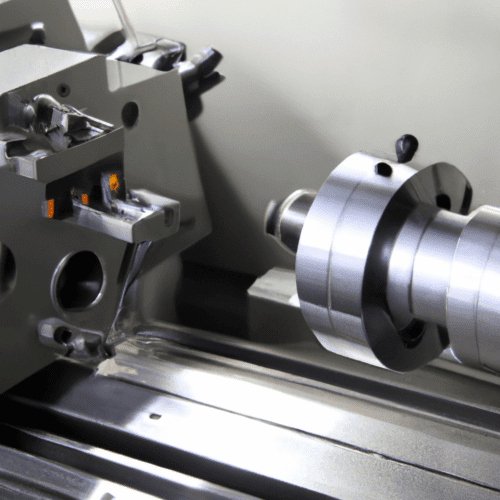
The CNC lathe has fundamentally transformed precision manufacturing, offering significant advantages over traditional manual machining methods. Its integration of computer numerical control allows for automated, highly accurate, and efficient production of cylindrical and rotational parts. Industries from aerospace to medical devices rely on CNC turning for components requiring stringent specifications and consistent quality.
CNC lathes excel in producing complex geometries with exceptional precision and repeatability, minimizing human error and reducing material waste. This automation also enhances workplace safety by reducing direct operator interaction with cutting tools.
Achieving Superior Geometric Accuracy
CNC lathes deliver high roundness accuracy, a critical factor for components like bearings, shafts, and hydraulic cylinders. Precision turning operations can control roundness tolerances to ≤ 0.003 mm and cylindricity to ≤ 0.005 mm. For highly critical applications, such as aerospace bearings, roundness deviation might be specified to less than 1 µm to prevent vibration and premature failure.
The International Organization for Standardization (ISO) provides comprehensive standards like ISO 1101, which defines geometric tolerances, including roundness. This standard uses symbols and values to communicate required accuracy levels, ensuring global consistency in manufacturing specifications. Such tight control over geometric features is paramount for part functionality and longevity.
Machine tool accuracy and repeatability are rigorously tested using standards such as ISO 230-2. This standard evaluates the positioning accuracy and repeatability of numerically controlled axes, ensuring that a machine consistently reaches commanded positions and repeats movements under identical conditions. A well-calibrated CNC lathe can achieve X-axis positioning accuracy (A) of ≤ 0.015 mm and repeatability (R) of ≤ 0.008 mm.
Automated Thread Cutting Capabilities
| Parameter | Standard CNC Turning | Precision CNC Turning |
|---|---|---|
| Linear Tolerance | ±0.127 mm (±0.005 in) | ±0.025 mm (±0.001 in) to ±0.0127 mm (±0.0005 in) |
| Roundness Tolerance | Typically within ±0.005 mm | ≤ 0.003 mm (≤ 1 µm for critical applications) |
| Surface Finish (Ra) | 1.6 – 6.3 µm (63 – 250 µin) | 0.4 – 0.8 µm (16 – 32 µin) or better |
| 304 Stainless Steel Cutting Speed (Carbide) | 150–220 m/min (492–722 SFM) | 200–350 m/min (656–1148 SFM) (Cermet/CBN for finishing) |
| 304 Stainless Steel Feed Rate (Finishing) | 0.05–0.15 mm/rev | 0.10–0.20 mm/rev (with wiper insert for Ra < 1.6 µm) |
| Aluminum 6061 Cutting Speed (Carbide) | 180–365 m/min (600–1200 SFM) | Higher speeds possible with optimized tooling |
| Aluminum 6061 Feed Rate (Roughing) | 0.10–0.25 mm/rev (0.004–0.010 IPR) | 0.05–0.125 mm/rev (0.002–0.005 IPR) (Finishing) |
Automated thread cutting on CNC lathes represents a significant advancement over manual methods, ensuring high precision and consistency. The CNC system precisely controls the tool’s movement, pitch, and depth of cut, allowing for the creation of various thread forms, including standard, metric, and specialized profiles. This capability is integral to producing fasteners, fittings, and other components requiring reliable connections.
The integration of CAD/CAM systems further enhances automated thread cutting by allowing engineers to simulate machining processes before production. This reduces errors and optimizes the cutting path, ensuring that threads meet exact specifications and tolerances. The ability to program complex thread patterns eliminates the need for specialized taps or dies, streamlining the manufacturing process.
Efficient Tool Turret Switching
CNC lathe tool turrets are rotating tool holders that significantly enhance machining efficiency by allowing rapid and automatic tool changes. These turrets can hold multiple tools, such as drills, boring bars, and turning tools, and rotate to the correct station in seconds. This eliminates manual tool changes, which are time-consuming and prone to operator error.
The rapid tool switching capability of a turret is crucial for complex machining processes that require multiple operations, such as roughing, finishing, and threading, within a single setup. This continuous operation reduces idle time and boosts overall productivity. Turret indexing repeatability is also a key performance metric, with some machines achieving ≤ 0.005 mm across 30 indexing cycles.
Reduced Part Cycle Times
CNC lathes significantly reduce part cycle times by optimizing machining processes and minimizing manual intervention. Automated tool movements, high-speed spindle operations, and optimized cutting paths enable faster material removal compared to traditional methods. This efficiency is critical for high-volume production and meeting tight deadlines.
Cycle time reduction often focuses on minimizing ‘idle time’ rather than just cutting time, as changing cutting conditions can affect workpiece precision. Strategies include reviewing and optimizing NC programs to eliminate unnecessary movements and waiting times. Simultaneous operations, such as indexing the turret while the spindle begins rotation, further reduce non-cutting time.
Program optimization also involves reducing the ‘R-plane’ (rapid plane), which is the position the spindle moves to above the part before cutting. Setting this plane closer to the workpiece minimizes rapid traverse distances, saving valuable seconds on each part. These small optimizations accumulate to significant time savings over large production runs.
Repeatable Production Runs and Consistent Quality
One of the most compelling advantages of CNC lathes is their ability to deliver highly repeatable production runs with consistent quality. Once a program is established, the machine can reproduce identical parts repeatedly without deviation, which is invaluable for industries requiring interchangeable components. This stable repetition accuracy reduces rejection rates and enhances production reliability.
The integration of CAD/CAM systems ensures that design data is directly converted into precise machining instructions, leading to a high level of repeatability and dimensional control. This minimizes human error, a common source of inconsistency in manual machining, and ensures that every finished part meets the same technical standards. Modern CNC lathes, with their advanced automation and self-monitoring systems, can operate 24/7 without human intervention, further ensuring consistent output.