
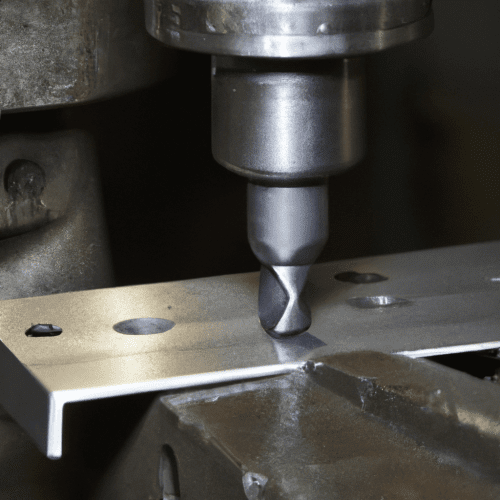
Metal milling is a subtractive manufacturing process that precisely removes material from a workpiece using rotating multi-point cutting tools. This method is fundamental to producing components requiring stringent dimensional control and robust mechanical properties. Modern CNC milling machines, controlled by sophisticated software, automate intricate processes, significantly enhancing efficiency and production speed across various industries.
The capabilities of CNC milling extend far beyond simple material removal, enabling the creation of complex shapes with unparalleled accuracy. This technology has become a cornerstone in sectors demanding high precision, such as aerospace, medical, and automotive manufacturing.
Precision and Repeatability in Metal Milling
Achieving high dimensional accuracy is a primary advantage of metal milling. CNC machines can consistently produce parts with tight tolerances, often within ±0.001 inches (0.025 mm) for standard operations, and even as tight as ±0.0005 inches (0.0127 mm) for high-precision applications.
Machine rigidity forms the foundation of this precision, minimizing vibrations and deformation during cutting. Well-engineered machine bases, often made from heavy materials like cast iron, provide a stable foundation. Spindle assemblies designed for high stiffness, along with hardened guideways and ball screws, ensure precise tool positioning and smooth, accurate motion under dynamic loads.
Repeatability, the consistency of producing identical parts under the same conditions, is another critical aspect. Advanced control software and real-time monitoring systems contribute to this, allowing machines to detect and correct even slight deviations. This ensures that each component is an exact replica, vital for complex assemblies where parts must fit and function flawlessly.
Achieving Superior Surface Finishes
| Material | Typical CNC Milling Ra (µm) | Typical CNC Milling Ra (µinch) | Notes |
|---|---|---|---|
| Aluminum (General) | 1.6 – 3.2 | 63 – 125 | Standard finish for non-critical areas. |
| Steel (General) | 1.6 – 3.2 | 63 – 125 | Achievable with standard milling. |
| Precision Machining | 0.8 – 1.6 | 32 – 63 | Optimal for O-ring grooves, press-fits, and standard mating parts. |
| High Precision | 0.4 | 16 | Requires fine turning or precision grinding, mandatory for high-pressure fluid seals. |
Metal milling excels at producing excellent surface finishes, a crucial factor for component performance, aesthetics, and longevity. The surface finish, often measured by Ra (Roughness Average), describes the microscopic peaks and valleys left on a part after cutting.
Several interacting variables influence the resulting surface finish, including tool geometry, cutting parameters like spindle speed and feed rate, and the use of coolants. Finishing passes typically involve higher cutting speeds and reduced feed rates to achieve smoother surfaces.
For optimal results, specialized tools such as wiper inserts or cermet inserts can be employed to achieve near-mirror finishes. Proper chip evacuation, often aided by air blasts or flood coolant, also prevents material from sticking to the cutting tool, which can degrade the surface finish.
Here is a comparison of typical surface finishes achievable with CNC milling for common materials:
Versatile Material Options for Diverse Applications
Metal milling accommodates an extensive array of materials, making it highly versatile for countless applications. Common metals include various aluminum alloys, steels, stainless steels, and titanium. Each material possesses unique properties that dictate its suitability for specific end products.
Aluminum alloys, such as 6061-T6, are frequently milled due to their excellent machinability, high strength-to-weight ratio, and corrosion resistance. They are ideal for aerospace components, automotive parts, and consumer electronics where lightweight yet robust structures are essential.
Steels, including mild steel and various tool steels, offer superior strength and hardness, making them suitable for heavy-duty industrial machinery, molds, and structural components. Stainless steels, like 304 and 316, provide enhanced corrosion resistance and are critical for medical devices, food processing equipment, and marine applications.
Exotic materials such as titanium alloys are also routinely milled for high-performance applications in aerospace and medical industries. These materials offer exceptional strength, biocompatibility, and resistance to extreme temperatures, albeit requiring specialized cutting tools and optimized feeds and speeds.
Unlocking Complex Geometries and Features
Modern metal milling capabilities allow for the creation of highly complex geometries that were once impossible or prohibitively expensive. Multi-axis CNC machines, including 3-axis, 4-axis, and 5-axis configurations, are instrumental in achieving intricate designs.
Five-axis milling, for instance, enables simultaneous movement along three linear axes and two rotational axes, allowing the cutting tool to approach the workpiece from virtually any angle. This capability facilitates the machining of internal features, undercuts, deep pockets, and intricate contoured surfaces in a single setup, reducing manufacturing time and improving accuracy.
Advanced techniques like high-speed milling and trochoidal milling further enhance the ability to produce complex parts efficiently. High-speed milling minimizes tool wear and improves surface finishes, while trochoidal milling uses circular tool paths to reduce cutting forces, particularly beneficial for deep slotting and hard materials.
Engineering Durable End Products
The inherent strength and integrity of milled metal components contribute significantly to the durability of end products. Unlike additive manufacturing processes, milling starts with solid blocks of material, ensuring consistent material properties throughout the part. This results in components with high mechanical strength, fatigue resistance, and structural stability.
Material selection plays a crucial role in achieving desired durability. For example, aerospace components, such as turbine blades and landing gear, demand materials like titanium and high-strength aluminum alloys that can withstand extreme temperatures, constant wear, and immense forces. Precision milling ensures these materials are shaped to exact specifications, maximizing their performance and lifespan.
Industries like medical and automotive heavily rely on the durability of milled parts. Medical implants, surgical instruments, and critical engine components require materials that are not only strong and resistant to wear but also biocompatible or capable of enduring harsh operating environments. CNC milling provides the precision necessary to meet these rigorous demands, ensuring product reliability and safety.